by Impuls Educació
Four prominent voices with deep expertise in the Catalan educational ecosystem convened for a roundtable symposium on effective educational leadership, chaired by Xavier Chavarría. The panel featured Mireia Tintoré, PhD in Humanities and Social Sciences, tenured professor, and founder of the Iberian Observatory of Educational Leadership; Ignasi García Plata, educator, school inspector, and former Secretary of Educational Policies; Meritxell Ruiz, Secretary General of the Foundation of Christian Schools and former Catalan Minister of Education; and Anna Jolonch, director of LID BARCELONA – Center for Educational Leadership, PhD in Educational Sciences, and head of research at the Jaume Bofill Foundation. Their insights converged on four non-negotiable conditions for optimizing instructional leadership: a robust institutional culture, a strategic vision that balances long-term objectives with manageable short-term milestones, a leadership preparation model that dismantles the false dichotomy between equity and excellence, and a framework of school autonomy anchored in co-responsibility and systemic stability.
Culture as the Invisible Foundation: Climate, Values, and Empowering Leadership
Mireia Tintoré opened the discourse with an evocative iceberg metaphor: organizational climate is the visible manifestation of a school’s environment—the palpable atmosphere of order, high expectations, well-being, and rigorous learning encountered upon entering—yet it represents merely the tip of the iceberg. The submerged foundation that sustains the entire organization comprises its core values, shared meanings, and deep institutional culture.
To engineer a positive climate optimized for learning and socio-emotional well-being, institutions must explicitly define their guiding ethical values, which serve as the scaffolding for the school’s vision. Primary accountability for operationalizing this vision rests with the executive leadership team, who must model these values through daily clinical practice and safeguard a secure, nurturing environment. As scholars like Karen Seashore Louis have demonstrated, relational trust forms the bedrock of leadership, meaning that collective teamwork and individual interactions carry equal strategic weight.
Another critical pillar is distributed leadership, re-conceptualized here as empowering leadership. Far from the mere delegation of tasks, true distributed leadership empowers individuals to actively assume authentic executive responsibility. This distributed framework must prioritize middle leadership roles, such as department heads and guidance counselors. Drawing on Andy Hargreaves’ paradigm of leading from the middle, these professionals must transcend functioning as mere transmission belts, positioning themselves instead as core engines of change. Concurrently, cultivating teacher leaders—professionals wielding significant instructional influence both inside and outside the classroom—is highly advisable. Ultimately, academic rigor, mutual respect, individual care, and collaborative workflows consolidate a professional climate where educators genuinely thrive.
Distributed leadership is never about the mere delegation of tasks; it is about systematically empowering individuals to own authentic executive responsibility.

Strategic Horizon, Incremental Steps: Balancing Long-Term Vision and Short-Term Execution
Drawing from her extensive executive and governmental tenure, Meritxell Ruiz addressed the challenge of pacing institutional transformation with equilibrium. Leaders must dynamically calibrate both temporal horizons: failing to identify the long-term destination stalls forward momentum, yet neglecting the immediate roadmap breeds deep institutional frustration.
Ruiz warned that the over-saturation of grandiloquent rhetoric surrounding innovation and transformation has frequently sparked apprehension and change fatigue among teaching faculties. Consequently, it is far more effective to pair an ambitious long-term vision with highly feasible, incremental steps. Guided by a collective reflection on the school’s future, leadership must isolate actionable, short-term objectives.
These incremental milestones must be tightly grounded in the unique reality of each school site and the pre-existing expertise within its classrooms. Because every educational institution operates within its own localized context, enforcing uniform transformation templates uniformly across all schools is a critical error. True progress is unlocked by cultivating a shared vision, mapping out digestible operational steps, and initiating change directly from the current baseline of the faculty.

Securing a long-term strategic horizon requires executing short, highly feasible steps rooted directly in the localized reality of each educational institution.
Dismantling the False Dichotomy: Equity and Excellence as Interdependent Goals
Anna Jolonch reframed leadership preparation by challenging a pervasive educational cliché, arguing that the perceived tension between systemic efficacy and equity—as well as between equity and excellence—is an absolute false dichotomy. As Professor Ferran Ferrer has masterfully documented, equity and excellence can and must operate in tandem. Cultivating equity entails guaranteeing that the entire student demographic possesses rich learning opportunities, thereby enabling each individual student to achieve their own distinct pinnacle of excellence.
Actualizing this standard demands a profound paradigm shift in leadership training, steering professional development toward tangible impact within schools and classrooms. This requires embedding job-embedded, inquiry-based methodologies, such as learning walks, peer-to-peer cross-institutional school visits, structured mentoring, and lesson studies. These practices—predicated on the collaborative observation of student learning and constructive peer feedback—forge a genuinely collaborative professional culture.
Furthermore, school leaders must actively engage in professional learning networks to mitigate the structural isolation inherent to the role and accelerate peer-led growth. Finally, the system requires a rigorous professional competency framework for school leadership to guide the training, capacity building, and formative assessment of educational executives.
Equity and excellence are profoundly symbiotic: working toward true equity means ensuring every student is structurally supported to reach their own unique excellence.

Autonomy with Intent: Co-Responsibility as a Structural Condition
Ignasi García Plata, leveraging his extensive experience within educational administration, reframed the discourse around macro-structural parameters. He posited that the public administration carries two non-negotiable mandates: articulating a clear, macro-level purpose focused on high-quality outcomes and equity, and equipping local schools with the statutory tools necessary to actualize those goals.
The codification of the Catalan Education Law (LEC), alongside subsequent decrees governing school autonomy, instructional leadership, and human resources, marked a milestone in structural policy. This framework drew inspiration from pioneering initiatives like the School Autonomy Plans, championed by educational leaders such as Jesús Moral, Eugeni García, and Marta del Campo. Those early roadmaps anchored themselves in participatory strategic planning, asymmetric resource allocation, continuous field support, and rigorous accountability.
In the current landscape, a pivotal mechanism is the statutory capacity of schools to define specialized, profiled teaching posts, filled via accredited professional learning or demonstrated clinical experience. Within the context of language immersion, García Plata advocated for reclaiming foundational pedagogical touchstones, such as Josep Maria Artigal or Ignasi Vila, to aggressively confront the contemporary emergency surrounding the socio-linguistic use of the Catalan language.
Consolidating this decentralized model requires securing faculty stability by aggressively mitigating excessive teacher turnover and ensuring that specialized, profiled positions can be filled by tenured civil servants through targeted competitive examinations. Furthermore, it is essential to operationalize the statutory role of the expert teacher already encoded in legislation to formally validate instructional excellence and systemic commitment to school improvement. These master educators could then spearhead internal mentoring and instructional leadership workflows without being decoupled from classroom practice.
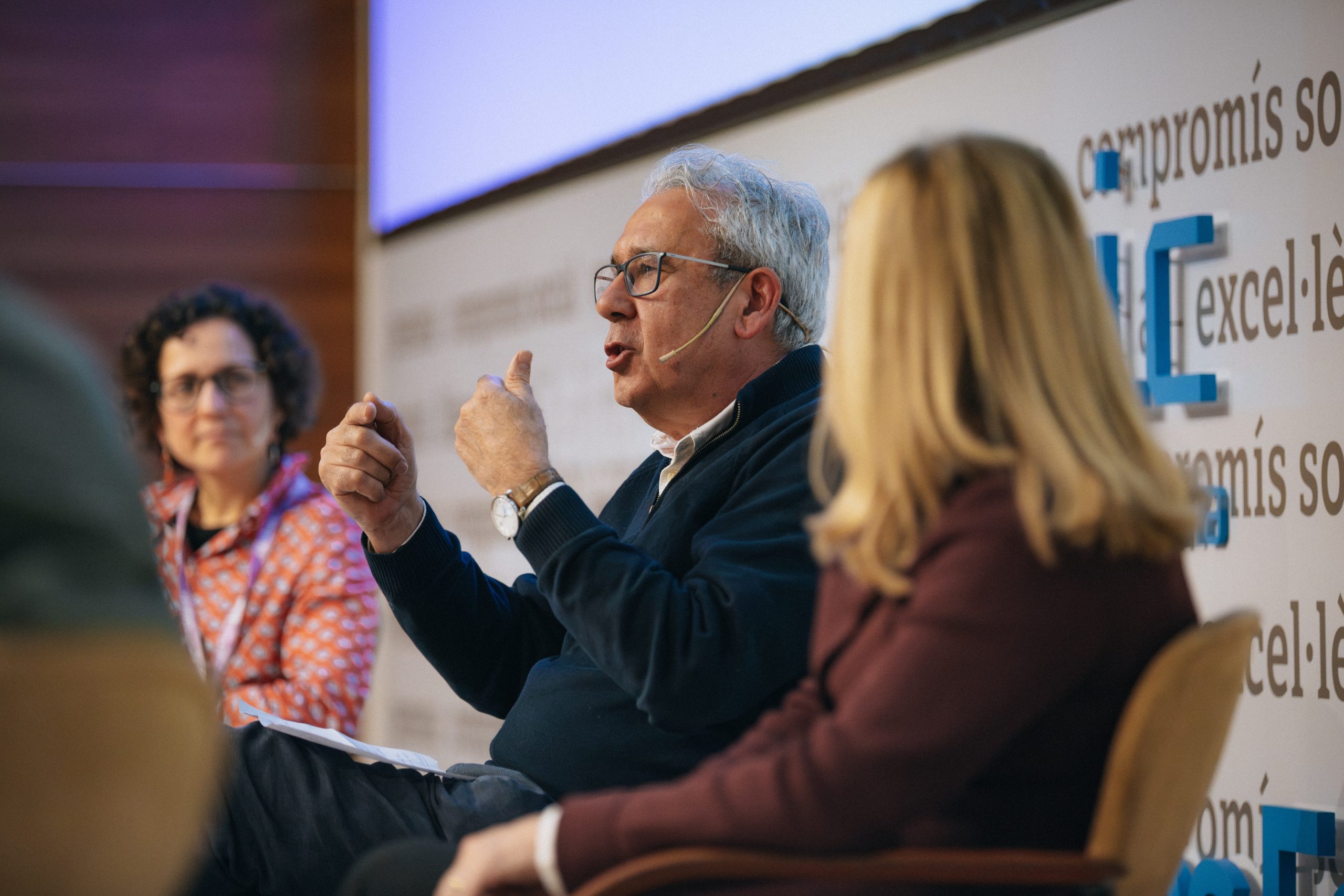
The public administration bears two fundamental obligations: establishing a clear systemic purpose anchored in equity, and provisioning the exact tools required to achieve it.
Stability, Resource Allocation, and Governance: The Missing Systemic Links
The moderator’s concluding prompt regarding equity-based asymmetrical funding models and standardized competency frameworks elicited four highly complementary structural critiques.
Anna Jolonch identified chronic institutional instability as a primary impediment to the successful execution of macro-educational policies. Unceasing political shifts within central administrations systematically disrupt and truncate local school projects before they can consolidate. She argued for a strict structural firewall between transient political agendas and technical educational competence. Moreover, the structural diversity of school sites must never degenerate into systemic inequality; funding mechanisms must remain asymmetrical to precisely mirror the distinct socioeconomic realities of each institution, flatly rejecting standardized, one-size-fits-all funding formulas.
Mireia Tintoré reinforced this perspective by drawing on international comparative data. During a research expedition to Portugal organized by the Iberian Observatory of Educational Leadership, her team observed that highly vulnerable schools serving concentrated cohorts of students with special educational needs are provisioned with vastly superior staffing allocations compared to local baselines. Inclusive policy frameworks, she reminded the panel, are entirely hollow unless accompanied by the robust human and fiscal capital required to render them structurally viable.
Meritxell Ruiz clarified that the ecosystem demands optimized structural conditions, not merely uncoordinated resource injections. Political predictability and teaching staff stability are absolutely foundational. Systemic governance must be drastically refined: the public school sector requires the nimble, flexible personnel governance mechanisms characteristic of the charter school network, while the publicly subsidized private sector urgently requires fiscal parity with public school funding. Ultimately, restoring absolute professional trust in classroom teachers and executive leadership teams—fully validating their localized expertise in school operations—is imperative.
Ignasi García Plata concluded the panel by asserting that while asymmetric funding models are vital to mitigate demographic complexity, they must never be strictly tied to raw performance outcomes. Schools navigating complex, high-needs environments must simply be structurally provisioned with permanently expanded staffing ratios. The true paradigm shift lies in cementing robust school autonomy through formalized co-responsibility agreements with central authorities, built on participatory strategic planning, personnel stability, and continuous formative evaluation. Utilizing contextualized school indicators—which allow for objective benchmarking against institutions operating under comparable socio-demographic complexity—serves as a powerful mechanism to ground improvement roadmaps in empirical data, steering the entire ecosystem toward continuous, iterative optimization.
Diversity must never be permitted to degenerate into systemic inequality; asymmetrical funding allocations are the only equitable response to localized institutional realities.

Rate the post
You might be interested