Judgement Cannot Be Delegated · 6 of 12
It is commonly accepted that teenagers, who have grown up with a screen in their hand, notice straight away when a text has been written by a machine, and that it is enough to teach them to be a little more distrustful. It would be worth observing, however, what happens when they are really taught.
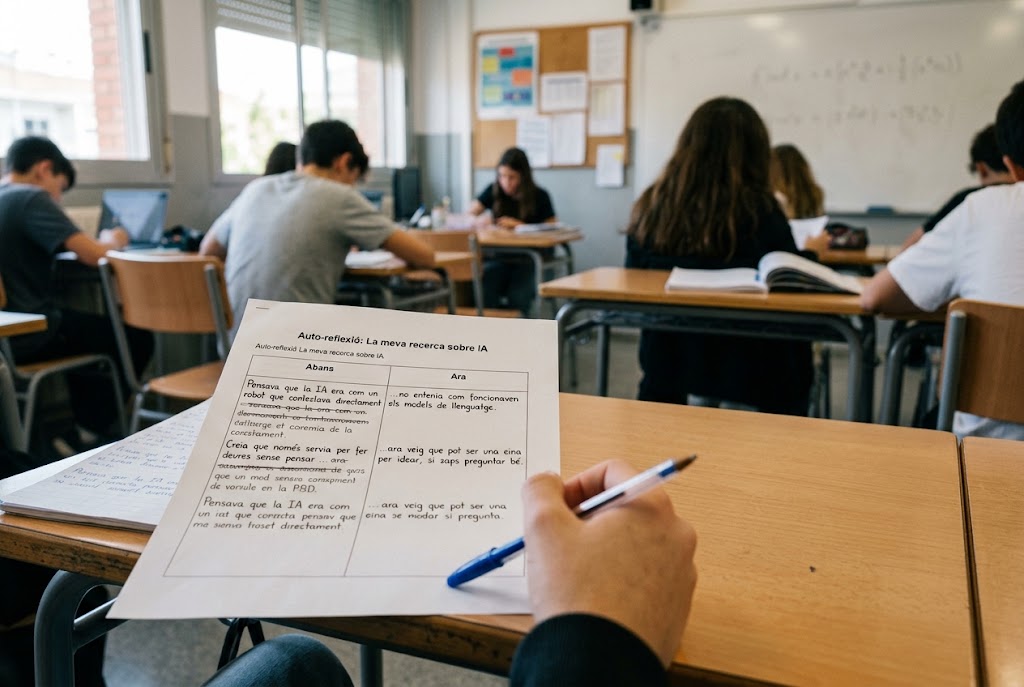
At a state secondary school in Catalonia, thirteen students in the first year of Bachillerato (Year 12) spent twelve sessions working on what generative artificial intelligence does and does not do. At the end, their teacher, Miquel Àngel Fuentes Arjona, a trainer in teachers’ digital competence, asked them to write down what they thought they knew before and what they knew now. Before, they said that AI ‘always told the truth’ and that it was neutral ‘because it is a machine’. Afterwards, that it sounds convincing, that it is not capable of verifying what it says, and that it is no longer so easy to tell what it has generated. It was a retrospective task, in which each student recounts their own change, and not a measure of learning. But what had changed, by their own account, was not their distrust, it was their repertoire. (1)
Distrusting is not a method
At the Colegio Juan de Lanuza in Zaragoza, students in Years 4 and 5 of primary school do an activity called ‘Sentence Detectives’: they are given twelve cards, six generated by an AI and six attributed to authors or historical figures, they classify them and explain which clues they are relying on. The assessment criterion set by its authors, a team of teachers coordinated by Cristian Ruiz Reinales, the school’s head of technology, is what gives the whole activity its meaning: justifying matters more than getting it right. (2)
This is not a kindly concession. It is a decision about what is being taught. Guessing the origin of a text is not a competence, because success does not depend on the student, but on how well or badly the forgery has been made. Justifying is a competence, and it can also be assessed.
It is worth defining what we are talking about when we say critical thinking, since the term has become so broad that it serves for everything and therefore for nothing. A systematic review of fifty-two studies, coordinated by Iliana Guaranda-Arias at the State University of Milagro, describes it as a set of skills rather than as dispositions of character towards thinking well. Some of those operational skills are: analysing, evaluating evidence and arguing, to which are added identifying bias and justifying the pedagogical decision. (3) They are verbs, and together with the necessary attitudes of having an open mind, curiosity or the intention to seek the truth, they look more like intellectual virtues than mere dispositions. And verbs, and virtues, are educated and taught.
An international panel of experts convened by researchers at Linköping University, in Sweden, reached a consensus pointing in the same direction: to use AI responsibly students need to learn critical thinking, and critical thinking is the most important skill for examining bias, skewed data and deep fakes. (4)
In the second article in this series, ‘No Warning Light’, we saw that the fluency of a generated text does not guarantee its truth, because the system predicts words and does not check facts. In the fourth, ‘The Debt You Cannot See’, that the more confidence the user places in the tool, the less scrutiny they deploy. Both left open the question this article asks: what exactly is to be done on Monday morning.
Guessing the origin of a text is not an assessable skill; justifying it with evidence is.

Doubt has foundations
Evaluating an AI answer about the Spanish Civil War requires knowing about the Spanish Civil War. It seems obvious, doesn’t it? Well, the consequences are rather less so.
In the discussion of their study, the Linköping researchers offer a reading of that consensus that deserves attention. They take up the argument of the cognitive psychologist Daniel Willingham, according to whom critical thinking requires sufficient content knowledge, and they hold that the two categories into which their panel’s consensus is grouped, foundational knowledge about AI and critical perspectives, reflect that interdependence: knowledge is the foundation upon which reasoning and critical perspectives are built.
Alejandro Espeso-García, of the Catholic University of Murcia, reaches the same conclusion by another route. Without a base of knowledge established in long-term memory that allows the algorithm to be audited and corrected, there is no real oversight, only the appearance of oversight. That is why he proposes leaving behind the model in which the person merely validates what the machine produces, and moving towards another in which they retain final authority. (5)
And the practical consequence is already set down, in so many words, in the AI literacy framework of Digital Promise, led by Kelly Mills: generative AI systems should not be used to learn new information about a topic, because they tend to include subtly wrong information. (6) They are useful for working on what is already known. Not for finding out what is not yet known.
The conclusion that follows is ours, and it is worth saying so. AI does not make content knowledge dispensable. It makes it more necessary and changes its function: until now it served above all to produce answers, and now it also serves to audit them. A curriculum emptied of content because ‘the machine looks that up now’ leaves students without the instrument with which they might argue back at the machine.
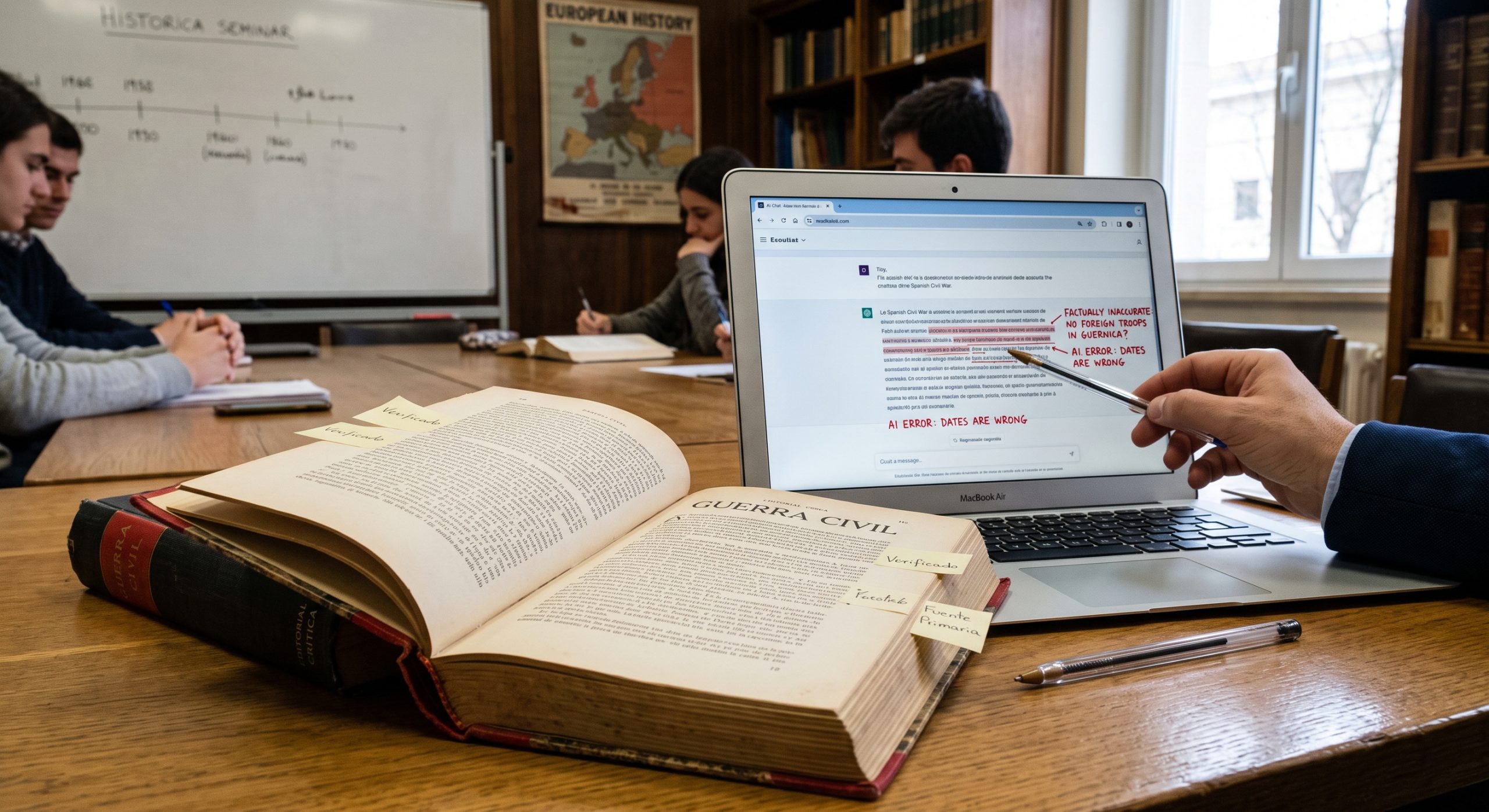
Prior knowledge in long-term memory is the only foundation capable of auditing the algorithm.
Leaving the page
In 2019, Sam Wineburg, professor of education at Stanford University, and Sarah McGrew, then a doctoral student at the same school, published a study that every teaching staff should know. They sat forty-five expert internet users in front of a computer, ten historians with doctorates, ten professional fact checkers and twenty-five first-year students, and asked them to think aloud, with the screen recorded, while they evaluated websites on controversial issues. (7)
One of the tasks consisted in assessing two articles on bullying from two organisations with almost identical names: the American Academy of Pediatrics, the largest association of paediatricians in the world, with sixty-six thousand members; and the American College of Pediatricians, a group that split off in 2002, with a few hundred members and a single full-time employee.
Every fact checker considered the Academy’s site more reliable. Sixty per cent of the students chose the splinter group’s. The historians equivocated.
What separated one group from the other was not reading better. It was reading less. The fact checkers left the page in about half a minute, opened new tabs and found out from outside who was behind what they had in front of them. The historians took almost three times as long to leave. The students, more than a minute and a half, and nine of the twenty-five never left at all. They learned more about a site precisely by leaving it early.
One detail gives the measure of the problem. Seven of the ten historians pointed to the references at the end of the article as proof that the article was reliable. Among those ten references there was one to an online dictionary and two to news blogs.
Wineburg and McGrew name three practices that explain the difference, and all three can be taught. Taking bearings: getting your orientation before going into unfamiliar content, like the walker who checks the compass before heading into the woods. Lateral reading: leaving the page and checking the source against what other sources say about it. And click restraint: reading the whole page of search results before clicking on the first one.
Verification requires leaving the page: opening external tabs to uncover who funds the source.

Practical application
In the classroom: the three-voices routine. The Colegio Juan de Lanuza project builds all its activities on a template that students repeat from primary school to Bachillerato: ‘AI says, the source says, I conclude’. It separates what the machine proposes from what can be checked and from what the person decides, and it leaves an assessable trail. In primary they discover and question; in the first and second years of ESO (Years 7 and 8) they experiment, compare and validate; in the third and fourth years (Years 9 and 10) they analyse and redesign; in Bachillerato they research and compare tools. (2)
In the classroom: asking for explanations, not answers. The same team trains students to ask the machine for local explanations, about a specific case; selective ones, a single reason that helps them improve; and, in secondary, comparative ones, why this answer and not another. In primary it starts with the question the Year 5 students put to an AI that has solved a problem badly: at which step did you go wrong. (2)
In the classroom: a lateral reading session. The CRAFT project at Stanford University, co-designed with teachers from several disciplines, publishes a sixty-minute lesson on how to fact-check what an AI answers, with a teacher’s guide and a student worksheet, introducing lateral reading on the basis of Wineburg and McGrew’s work. It is designed for Bachillerato and social sciences, and can be adapted to the fourth year of ESO (Year 10). (8)
For the school: a whole-school verification standard. The indicators of the Digital Promise framework are written as observable behaviours and can be turned into a stage-wide agreement: analysing and synthesising multiple perspectives to support lateral reading, citing valid, reliable data and evidence, and evaluating the credibility of an answer. (6) Formulating them as a standard is our own proposal based on the framework, not an instrument taken from it.
For the school: the teaching staff first. The Guaranda-Arias review indicates what teacher training should include here: case analysis, source verification, identification of bias and evaluation of AI-generated answers. With one caveat that its authors underline and that this blog is not going to hide: the relationship between AI literacy and teachers’ critical thinking appears as a conceptual one, supported by studies that are mostly documentary or cross-sectional, and does not allow causality to be asserted. (3) The ninth article, ‘What No One Can Learn on Their Own’, will deal with this.
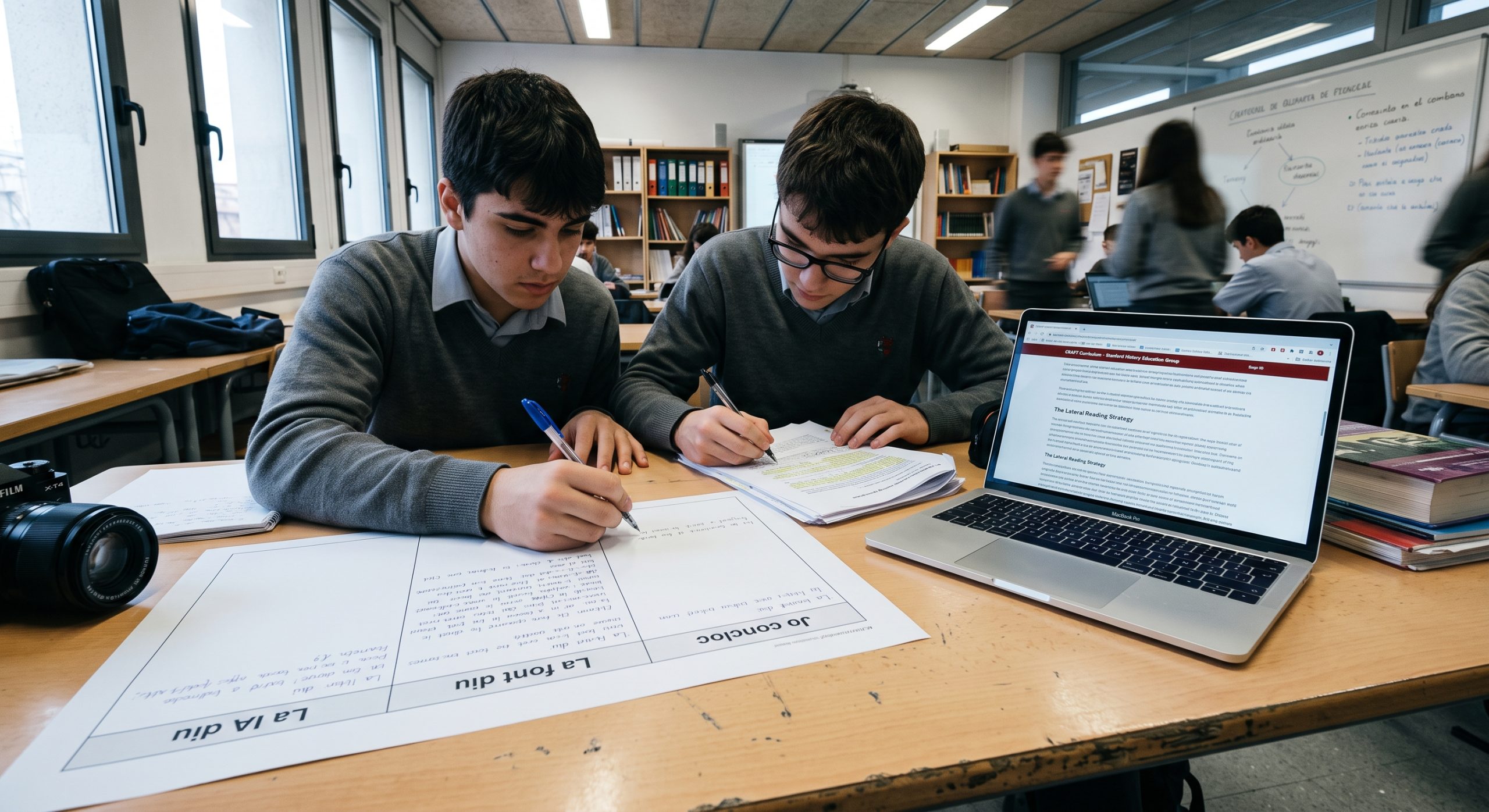
The ‘three voices’ routine separates the algorithmic response from the student’s own conclusion.
To conclude
Schools do not have to teach students to distrust artificial intelligence. Distrust is learned on one’s own, as soon as you have your first unpleasant surprise, and distrust without a method leads nowhere, because whoever suspects everything ends up believing anything. What schools have to teach is how to check. And checking requires knowing.
Food for thought. If tomorrow a student hands in a piece of work that is correct, well written and false, what specific procedure have they been taught in order to notice? And in which subject were they taught it?
Distrust without structure is useless; education must provide rigorous verification methods.

Glossary
- Critical thinking. A set of skills and dispositions that can be observed and assessed: analysing, evaluating evidence, arguing, identifying bias, justifying a decision and having an open mind, curiosity or a search for the truth. It is not a mere general attitude of suspicion.
- Lateral reading (or lateral verification). A strategy for evaluating the credibility of a source by comparing it with other, external sources. In practice it consists in leaving the page you are reading early, opening new tabs and finding out who is behind it.
- Click restraint. The practice of reading the whole page of search results, with its snippets of text, before clicking on any link.
- Content knowledge. What is known about the subject being discussed. It is the condition that makes it possible to detect an error in a generated answer: without it, the evaluation rests on the appearance of the text.
- Plausibility. The quality of a text that comes across as believable because of its form, its fluency and its confident tone, regardless of whether what it asserts is true.
- Explainability (XAI). The capacity of an AI system to offer comprehensible explanations of why it has produced a particular answer. In the classroom this translates into teaching students to ask for those explanations instead of simply accepting the output.
References
- Fuentes Arjona, M. À. (2026). Del «Me parece convincente» al «Lo verifico»: una experiencia sobre IA generativa para desarrollar el pensamiento crítico [From ‘It seems convincing to me’ to ‘I check it’: an experience with generative AI to develop critical thinking]. In Informe ODITE 2026. Claves para una nueva educación. Tendencias, retos y propuestas en la era de la IA [ODITE Report 2026. Keys for a new education. Trends, challenges and proposals in the age of AI]. Observatorio de Innovación Educativa y Cultura Digital, Asociación Espiral, Educación y Tecnología.
- Ruiz Reinales, C. (Coord.), Fernández, J., Aguado, R., Guallar, A., and Pérez, G. (2026). IA para pensar mejor: cuando la escuela enseña a dudar, verificar y decidir [AI for thinking better: when schools teach how to doubt, verify and decide]. In Informe ODITE 2026. Claves para una nueva educación. Tendencias, retos y propuestas en la era de la IA [ODITE Report 2026. Keys for a new education. Trends, challenges and proposals in the age of AI]. Observatorio de Innovación Educativa y Cultura Digital, Asociación Espiral, Educación y Tecnología.
- Guaranda-Arias, I. C., García-Ortiz, L. R., and Guerrero-Zambrano, M. (2026). Alfabetización ética en inteligencia artificial y pensamiento crítico del profesorado: una revisión sistemática reportada conforme a PRISMA 2020 [Ethical literacy in artificial intelligence and teachers’ critical thinking: a systematic review reported in accordance with PRISMA 2020]. Innova Science Journal, 4(3), 964–974. https://doi.org/10.63618/omd/isj/v4/n3/393
- Hallström, J., Mannila, L., Nordlöf, C., Heintz, F., Sperling, K., and Stenliden, L. (2026). AI literacy for K-12 education: an international Delphi study. Interactive Learning Environments. https://doi.org/10.1080/10494820.2026.2649553
- Espeso-García, A. (2025). Generative artificial intelligence: Between enhancement and cognitive offloading. Cultura, Ciencia y Deporte, 20(66), section ‘The Challenge of Generative AI Literacy’. https://doi.org/10.12800/ccd.v20i66.2698
- Mills, K., Ruiz, P., Lee, K., Coenraad, M., Fusco, J., Roschelle, J., and Weisgrau, J. (2024). AI Literacy: A Framework to Understand, Evaluate, and Use Emerging Technology. Digital Promise. https://doi.org/10.51388/20.500.12265/218
- Wineburg, S., and McGrew, S. (2019). Lateral reading and the nature of expertise: Reading less and learning more when evaluating digital information. Teachers College Record, 121(11), 1–40.
- Mah, C. (2025). How do I fact-check AI search results? CRAFT: Classroom-Ready Resources About AI for Teaching, Stanford Graduate School of Education and Institute for Human-Centered AI. https://craft.stanford.edu/
Rate the post
You might be interested