
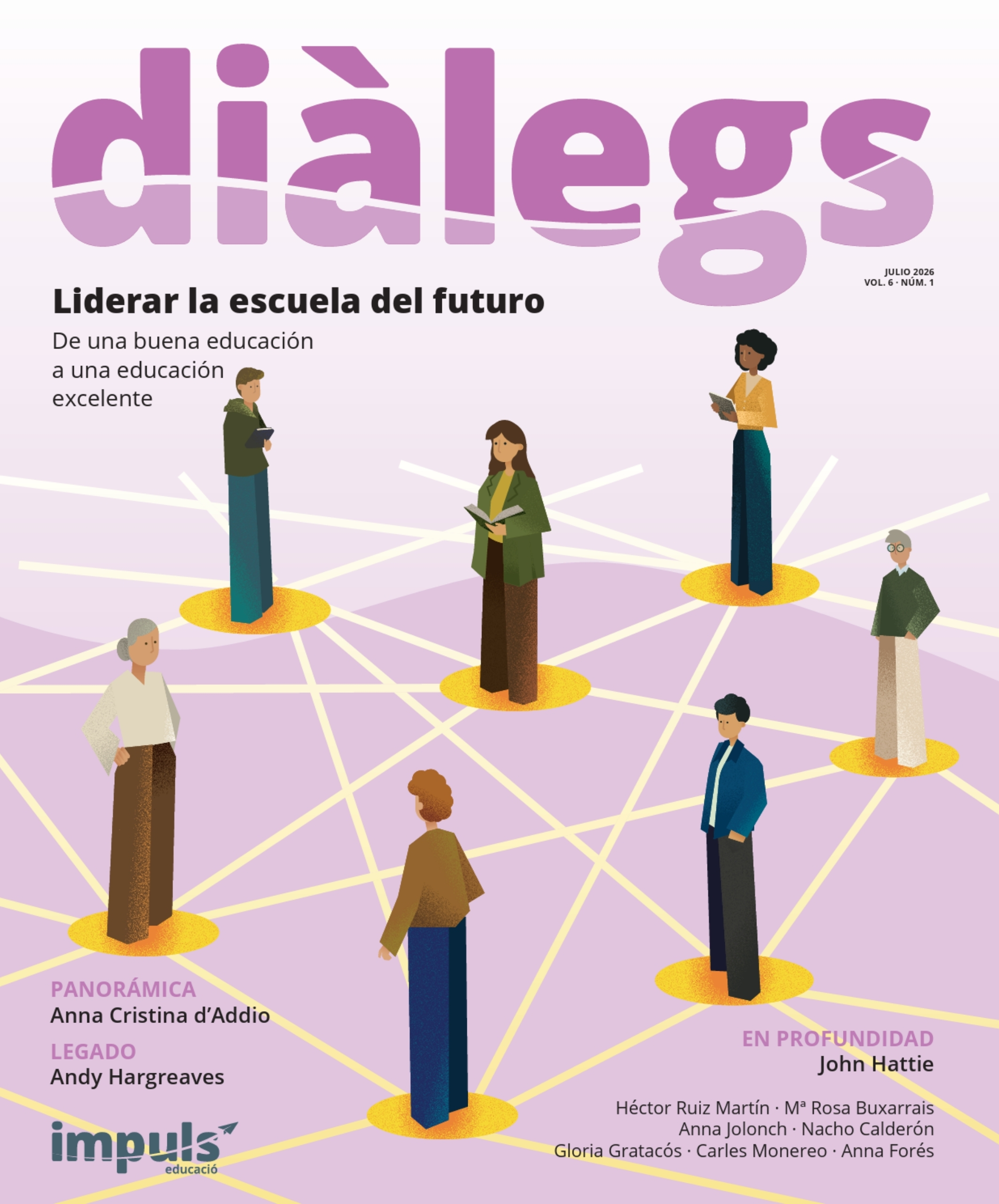
by Impuls Educació
Four preeminent voices convened at the panel discussion dedicated to leadership for learning, moderated by Montse Jiménez. The panel featured Héctor Ruiz Martín, science communicator and founder of the International Science Teaching Foundation; Ignacio Calderón Almendros, Professor at the University of Málaga and a leading authority on inclusive education; Mercè Gisbert, Professor at the Universitat Rovira i Virgili specializing in educational technology; and Neus Lorenzo, educational consultant and expert in digital policies. Four key principles underpinned their contributions: buffering teaching staff through evidence-based practices, transforming the educational institution into an ethical digital ecosystem, reshaping school culture by exposing the hidden suffering caused by exclusion and pathologization, and repurposing data metrics for continuous improvement rather than compliance-driven control.
Evidence and Professional Learning: School Leadership as a Shield for Faculty
Héctor Ruiz Martín opened the panel by noting that the UNESCO GEM Report identifies teacher quality as the premier school-level variable driving student outcomes, aligning with John Hattie’s extensive meta-analyses. The leverage of leadership thus resides in scaffolding educators to refine their clinical practice by providing robust professional learning, actionable tools, and targeted support within instructional workflows. A defining function of school leadership is to buffer faculty from external distractions, allowing them to focus squarely on core instruction.
This support is anchored in professional development. All too often, schools are subjected to professional learning that lacks empirical grounding, including pseudoscientific frameworks masquerading as science. The mandate of leadership is to guarantee that educator development aligns strictly with the best available evidence. School leaders must first build their own capacity to discern which interventions hold a high probability of classroom efficacy and which should be discarded.
With respect to innovation, Ruiz-Martín flagged two pervasive pitfalls. The first is treating innovation as an ultimate objective rather than a strategic mechanism to resolve a discrete problem. The second is superficial innovation—altering the aesthetics without shifting underlying pedagogical principles. A clear manifestation of this error is leveraging technology merely to replicate analog workflows—such as displaying a traditional textbook on a digital screen—offering zero marginal value. To navigate these choices, he recommended anchoring decisions in established international clearinghouses like the Education Endowment Foundation (EEF, UK) or the What Works Clearinghouse (WWC, USA), while localized benchmarks continue to mature.
Strategic leadership buffers faculty from external pressures, enabling a relentless focus on core instruction.

Architects of Digital Ecosystems: Leadership in the Era of AI
Neus Lorenzo reframed the digitalization discourse with a foundational premise: the critical question is not the trajectory of technological evolution, but our pedagogical intent. School leaders must position themselves as architects of ethical, sustainable, and high-impact digital ecosystems. This stewardship invariably begins with institutional realities: optimizing available infrastructure and transforming instructional practices to meet evolving student needs.
As ecosystem architects, leaders must adopt a multi-sectoral lens. The European Union Artificial Intelligence Act (the EU AI Act) already mandates that organizations maintain transparency regarding how they deploy these technologies. Consequently, it is imperative to map how AI permeates the institution and to co-construct shared protocols and guardrails for responsible deployment.
The digital ecosystem must directly serve the instructional priorities of the school’s charter: deepening learning, advancing inclusion, and scaffolding vulnerable student populations. School administration should provide scaffolded, evaluative sandboxes for experimentation, leveraging family partnerships and active student agency. The objective is never digitalization for its own sake, but rather engineering a digital context that reinforces the educational vision, interfaces with the local community, and scales solutions through inter-school networks.

The overarching question is not how technology evolves, but the precise educational intent behind its deployment in the classroom.
Exposing Hidden Suffering: Inclusion as an Institutional Culture
Ignacio Calderón Almendros directed the dialogue toward the core tenets of inclusion and the moral taxonomy utilized to navigate diversity. The initial step, he argued, is to imbue the inclusive education charter with profound purpose. Inclusion is not a fleeting trend; it is an ethical response to a hidden, deeply institutionalized suffering within schools that impacts students, families, and practitioners alike. Unearthing this suffering gives moral weight to systemic transformation and bridges fragmented stakeholder groups across the community.
Simultaneously, the cognitive frameworks shaping educational thought and practice must be overhauled. Binary constructs of ‘good’ versus ‘bad’ students, deterministic notions of socio-educational destiny, and deficit-based expert models have been thoroughly naturalized. It is vital to dismantle the pathologization of variance, challenge counterproductive practices like grade retention or segregation, and lean into professional conflict, which institutions historically suppress.
Cultivating an authentic culture of inquiry within schools requires disrupting entrenched ‘common sense’. This paradigm shift cannot be driven solely by academia; the school community must actively co-reconstruct scientific knowledge. This is achieved by anchoring inquiry in lived experiences and emotional realities, synthesizing them with empirical evidence, and co-designing novel practices through biographical and participatory action research.
Inclusive education is not a passing trend; it is a direct intervention against the hidden, normalized suffering perpetuated by traditional schooling.

From a Culture of Compliance to a Culture of Actionable Data
Mercè Gisbert addressed the intersection of assessment and data analytics with a cross-cutting thesis: every educator must function as a leader of the formative learning process, an attribute rarely explicitly articulated within pre-service teacher preparation curricula. To steer this process effectively, instructional decisions must be data-informed.
From an applied research standpoint, Gisbert underscored the necessity of bridging higher education and the clinical realities of the classroom. It is critical to evaluate how technology transforms these landscapes through a longitudinal lens—spanning from early childhood settings through higher education. Utilizing activity theory as an analytical framework allows leaders to conceptualize the educational ecosystem holistically: the infrastructure deployed, the instructional design enacted, and the diverse stakeholders engaged. This structural mapping enables a rigorous evaluation of whether formative milestones have been achieved.
Crucially, a clear distinction must be drawn between basic digital literacy and true digital competence. Competence does not merely denote technical proficiency with a specific tool, such as ChatGPT; rather, it entails the judicious, seamless integration of that tool into instructional design. Qualitative diagnostics yield the contextual insights necessary to determine what interventions succeed in specific environments.
The primary hurdle, she warned, lies in data systematization. While schools possess a myriad of platforms that continuously harvest data, they routinely lack a coherent strategy to translate metrics into executive decision-making. It is necessary to map the school’s digital architecture and foster collaborative partnerships between university researchers and school systems. Higher education institutions can provide the analytical capacity and methodological expertise required to systematize the raw data that schools already generate.

Schools are awash in data but starved for strategy. The critical challenge is translating raw metrics into sophisticated, informed clinical judgment.
Strategic Levers of Change: Partnerships, Constructive Conflict, and Shared Capital
The moderator’s concluding prompt—asking each panelist to isolate a single lever of change to insulate the time allocated for instructional leadership—elicited four distinct yet deeply complementary frameworks.
Neus Lorenzo advanced a singular concept: partnership. Leadership entails forging high-performing teams and professional learning networks to scale shared resources and solutions. Generative and predictive artificial intelligence, for instance, can already execute pattern recognition and simulate complex spatial or operational designs—such as optimizing school grounds or managing school infrastructure. Given the abundance of existing platforms and empirical precedents, executive time should be spent scaling proven practices rather than perpetually reinventing workflows from scratch.
Ignacio Calderón offered a seemingly paradoxical proposition: cultivating institutional space for the highly improbable, which necessitates leaning into constructive conflict. Within participatory evaluation frameworks, when the voices of marginalized students are authentically elevated and their lived experiences of exclusion are laid bare, it triggers a systemic friction essential for true transformation. Participatory action research and citizen science empower communities to co-construct high-value knowledge that reshapes school environments from the inside out.
Mercè Gisbert advocated for sustained, embedded collaboration between higher education and K-12 systems. Through collaborative initiatives like the Projecte Pont, pre-service university students co-design and deploy custom technological interventions in classrooms, responding directly to authentic, site-based needs. This reciprocal exchange injects fresh pedagogical frameworks and tools, simultaneously enriching pre-service teacher preparation and the clinical practice of veteran educators.
Héctor Ruiz concluded the session with a candid appraisal of research mobilization. The bridge between academic research and the practitioner community remains underdeveloped, further complicated by systemic barriers in scientific publishing regarding paywalls, jargon, and layout constraints. For the interim, he recommended leveraging international clearinghouses that systematically synthesize and translate clinical research for practitioners, while working toward consolidating analogous, open-access translational databases within the regional landscape.
Partnership, constructive conflict, collaborative capital, and empirical evidence: four non-negotiable levers to insulate and protect the time required for deep instructional leadership.

Rate the post
You might be interested