Judgement Cannot Be Delegated · 8 of 12
Nobody now disputes that the problem with artificial intelligence is that it gets things wrong. That it invents data, that it attributes books to authors who did not write them, that it maintains a falsehood with the same assurance with which it maintains a truth. That was the subject of the article ‘No Warning Light’ in this series, and, for the moment, it remains a real problem. But it is not the only one, and it is probably not the biggest one either.
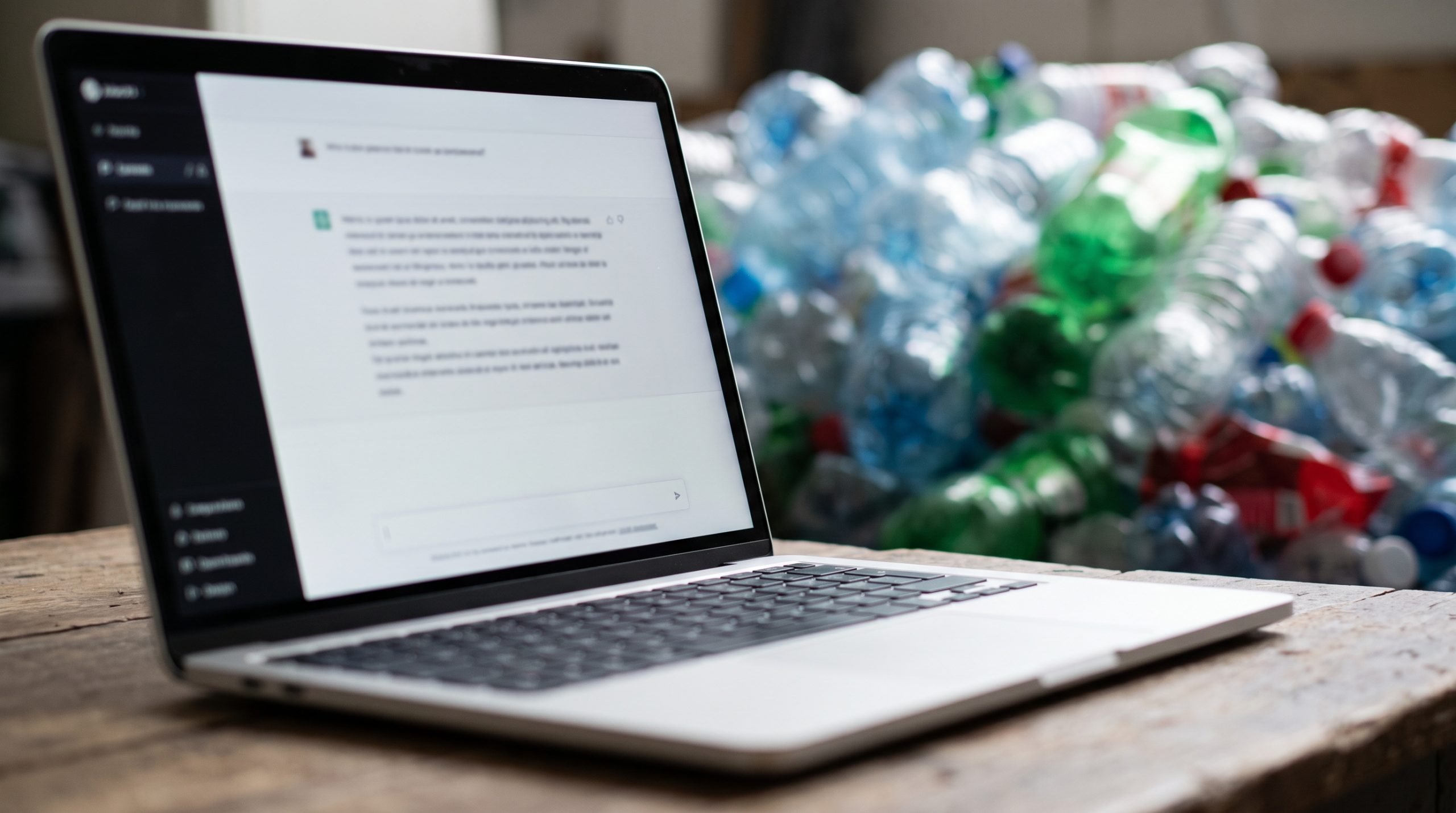
Like AI, plastic was not invented to be harmful either. Gunther Kress and Theo van Leeuwen, two of the founders of social semiotics, recall that since the 1930s plastic has been both celebrated and vilified: for its versatility, for its cheapness and for what it leaves behind once it has been used (1). Nobody disputes that it is useful. The problem arises when it accumulates.
Jasper Roe, of the School of Education at Durham University, with Leon Furze, a researcher at Deakin University in Melbourne, and Mike Perkins, director of the Centre for Research and Innovation at British University Vietnam, propose taking that comparison seriously. What generative artificial intelligence produces is, in their formulation, ‘ubiquitous, malleable, and persistent’, with ‘advantageous uses and potentially toxic implications’ (1). Hence the name they give it: digital plastic.

Neither good nor bad, and everywhere
They could have written a definition; instead they wrote a metaphor, and they chose it methodically.
Their work, published in 2026 in Pedagogies: An International Journal, applies the conceptual metaphor theory of the linguist George Lakoff and the philosopher Mark Johnson, which holds that metaphors are not an ornament of language but the structure with which we organise the world. The procedure has three steps: analysing the properties of the source material, which is physical plastic; looking for those same properties in the target material, which is AI-generated content; and then building the bridge between the two (1). This is a conceptual analysis, with no data of its own, proposing a way of looking. It is not an empirical study.
Three features hold the bridge up. The first is that generated content is cheap at the point of use: fast production, at scale, in any format and often at no direct cost to whoever commissions it. The second is that it is malleable, because meaning can be moved from one mode to another, from text to image, from image to voice, from voice to text. The third, and the one that gives this article its name, is that it is persistent.
And malleability has a price that the authors do not hide. A student can today produce the narration, the illustration and the soundtrack of a single piece of work without writing, drawing or recording anything. That broadens what they can end up saying. It can also lead them to prioritise efficiency over a voice of their own and to depend on algorithmic production even when they do not need it (1).
The advantage of thinking with a metaphor, rather than with a definition, is that it forces you to ask questions that technical vocabulary does not force you to ask. It occurs to nobody to ask a word processor whose data it amplifies. An ocean full of plastic does get asked who filled it.
Generating content automatically may prioritize speed over building one’s own voice.

What is left at the bottom
Physical plastic does not disappear: it fragments. The pieces become microscopic, they are called microplastics and they persist for decades in landfills and oceans, altering the ecosystem from within.
Roe, Furze and Perkins take the comparison all the way and speak of digital microplastics. Fragments of synthetic content accumulate in the training data of the following models, and there the metaphor stops being an elegant image and becomes a technical warning: the material the machine produces goes back into the web, and the next machine feeds on the web (1). It is the loop announced in the third article in this series.
To name the end of that loop, the authors draw on the work of Ilia Shumailov and his colleagues, published in 2024 in Nature: training a model on recursively generated content can lead to model collapse, a state in which the outputs become unintelligible and meaningless (1, 3). The article also describes it with an expression that says more to a teaching staff than any technicality: contamination of the dataset.
This should be read with the caution with which any projection is read. Nobody is claiming that collapse is going to happen, or when. What is claimed is that the risk comes from the properties of the material and not from a one-off misuse, and that the trace is already measurable: there are telltale adjectives, there are detectable footprints in the scientific literature and there is even a popular name for the rubbish flooding online spaces, AI slop (1).
Nor is the toxicity always subtle. In January 2025, Meta removed from Instagram and Facebook the AI-generated profiles the company itself had created, after the public backlash against the stereotypes those characters reproduced (1). It was not a system failure. It was the system working.

Feeding models with recursive synthetic content degrades the information ecosystem to the point of system collapse.
Teaching when not to use it as well
At this point, the question stops being about the technology and becomes ours. What needs to be taught in order to live in an environment like this.
The article’s answer has a name of its own: Critical AI Literacy, CAIL. The authors expressly distinguish it from AI literacy plain and simple, a term that, as they themselves admit, is ‘loosely defined and inconsistently applied with no universal definition’ (1). The adjective adds three things: understanding the technical foundations, recognising the social implications and seeing the power structures built into the system.
And it adds a fourth that has not yet appeared in any previous article in this series, because it is the most uncomfortable. Students need critical literacy, they write, partly in order to be able to ‘resist and refuse technologies and not simply use or consume them’ (1). Taken into the classroom, the criterion is concrete: use the generative tool when it better articulates what you want to say, and do not use it when the meaning is better conveyed without it. Deciding not to use it is part of the competence, not a renunciation of it.
Behind this lies a reason of justice, and it is the one that speaks most directly to a leadership team. The article ‘The World That Fitted in the Data’ in this series showed that giving everyone the same tool equalises nothing, because material access is not epistemic access. The Digital Promise AI literacy framework puts it from the other end of the problem: this is particularly crucial within the education system because ‘young people are being asked to engage with AI systems without choice about what tools they may use’ (2). Whoever did not choose the tool can hardly carry on their own the responsibility of defending themselves against it.
None of this calls for a new subject. The authors place critical literacy within the multiliteracies project, that is, within language, social sciences, art and tutorial time (1). It is the same criterion with which Stanford University’s CRAFT project designs its materials, expressly intended to be usable by teachers of any discipline (5). And it coincides with what the systematic review by Guaranda-Arias and colleagues indicates, placing disinformation and uncritical acceptance among the risks documented in the 52 studies reviewed, with the caveat, underlined by its authors, that these are mostly documentary or cross-sectional studies (4).
Deciding not to use the tool is part of competence, not a renunciation.

To take into the classroom and into the office
In the classroom: the digital plastic audit. For a week, each student records the content they consume and notes which of it they suspect is synthetic, why they suspect it and what it gives them. Afterwards it is classified together: useful uses, indifferent uses and toxic uses. The authors of the article invite readers to take the concept into classroom tasks and discussions, but they do not describe this activity: the specific proposal is ours (1).
In the classroom: seeing the bubble from inside. Somekone, the Social Media Machine of the Finnish project Generation AI, simulates a social network feed and makes visible in real time how each action by the user, looking, liking or scrolling past, generates data, builds a profile and determines what is recommended next. Students can modify the algorithm’s parameters and see how what they are shown narrows or widens. It runs entirely in the browser and takes no data out of the classroom (6). It works directly on one of the indicators of the Digital Promise framework: seeking information outside ‘filter bubbles’ (2).
In the classroom: justifying in writing the decision not to use it. In a piece of work where AI use is permitted, each student points out one place where they decided not to use it and explains why the result was better without it. It is the competence of resistance turned into an assessable task.
For the leadership team: centering justice as a criterion of the school plan. Digital Promise proposes four moves to promote awareness and agency across the whole community: learning how these tools work; communicating to families how they are used in the school and giving them the chance to opt in or out; helping to formulate the questions that almost nobody yet knows how to ask; and advocating for one’s own rights over data (2). Critical literacy cannot be left in the hands of each family’s cultural capital.
To conclude
Plastic is not the enemy. What has proved hard to manage has not been its existence, but its accumulation, its persistence and the slowness with which we learned to live alongside it. With synthetic content we are in the early phase of that same story, and this time with an advantage: we know from the outset what is accumulating.
Food for thought. If a student hands you a piece of work done entirely with generative tools, correct and well presented, would you be able to point out one place where it would have been better not to use them? And have you ever taught them that?
The educational challenge is not to ban the tool, but to manage its persistent accumulation.
Glossary
- Synthetic content. Text, image, audio or video produced by an artificial intelligence system instead of by a person. It does not mean false: it means generated.
- Digital plastic. A metaphor proposed by Roe, Furze and Perkins for synthetic content, by analogy with physical plastic: human-created, cheap, ubiquitous, malleable, persistent, useful and potentially toxic.
- Digital microplastics. Fragments of synthetic content that accumulate in the data used to train the following models and gradually degrade the quality of the information ecosystem.
- Model collapse. The deterioration a system can undergo when trained recursively on content generated by other systems, to the point of producing unintelligible outputs.
- Critical AI literacy (CAIL). The ability to analyse and use AI systems while understanding their technical foundations, their social implications and the power structures they build in, including the ability to decide not to use them.
- Multiliteracies. A pedagogical approach that extends traditional reading and writing to all the modes through which meaning is created today: image, sound, video and their combinations.
- Filter bubble. The effect whereby a recommender system narrows what a person sees until they are exposed almost only to content aligned with their profile.
References
- Roe, J., Furze, L. and Perkins, M. (2026). Digital plastic: a metaphorical framework for Critical AI Literacy in the multiliteracies era. Pedagogies: An International Journal, 21(2), 185–199. https://doi.org/10.1080/1554480X.2025.2557491
- Mills, K., Ruiz, P., Lee, K., Coenraad, M., Fusco, J., Roschelle, J. and Weisgrau, J. (2024). AI Literacy: A Framework to Understand, Evaluate, and Use Emerging Technology. Digital Promise. https://doi.org/10.51388/20.500.12265/218
- Shumailov, I., Shumaylov, Z., Zhao, Y., Papernot, N., Anderson, R. and Gal, Y. (2024). AI models collapse when trained on recursively generated data. Nature, 631, 755–759. Cited in (1). https://doi.org/10.1038/s41586-024-07566-y
- Guaranda-Arias, I. C., García-Ortiz, L. R. and Guerrero-Zambrano, M. (2026). Alfabetización ética en inteligencia artificial y pensamiento crítico del profesorado: una revisión sistemática reportada conforme a PRISMA 2020 [Ethical literacy in artificial intelligence and teachers’ critical thinking: a systematic review reported in accordance with PRISMA 2020]. Innova Science Journal, 4(3), 964–974. https://doi.org/10.63618/omd/isj/v4/n3/393
- CRAFT. Classroom-Ready Resources About AI For Teaching. Stanford Graduate School of Education and Institute for Human-Centered AI. Principle of multidisciplinarity. https://craft.stanford.edu/
- Generation AI. Somekone, the Social Media Machine. Consortium of the universities of Helsinki, Oulu and Eastern Finland, Codeschool Finland and Heureka. https://www.gen-ai.fi/en/tools/somekone
Rate the post
You might be interested