by Impuls Educació
Four distinctive Catalan educational experiences were featured in a panel moderated by Josep Maria Esteve, outlining a common, vital mandate: ensuring educational innovation is structurally sustained, empirically evaluated, and successfully scaled beyond institutional walls. The panel brought together Abraham de la Fuente, Director of the Institut Angeleta Ferrer in Barcelona—a public institution engineered from its inception as a systemic incubator for teacher training; Francesc Jiménez and Núria Samsó, Director and Quality Coordinator of the Institut de Gurb, showcasing an ISO 9001-certified management model and block-based formative assessment; Sandra Estrena and Carol Britos, Head of Innovation and Head of Primary Education at Escola Virolai, where three-year strategic roadmaps drive sustainable organizational growth; and Marc Colomer, Manager and Head of Educational Research at Innovamat, presenting a rigorous framework for responsible transformation.
Institut Angeleta Ferrer: Teacher Training as the Engine of the System
Abraham de la Fuente introduced a unique institutional model: a public secondary school deliberately designed to serve as a catalyst for the broader educational ecosystem. Established through a joint initiative of the Department of Education and the Barcelona Education Consortium, the Institut Angeleta Ferrer was built from the ground up to address areas of improvement in national educational outcomes by embedding teacher training and action research into its core operational design.
While the student body pursues standard state objectives, the institution expands its focus to encompass advanced teacher professional development. Rather than merely optimizing individual classroom performance, this framework aims to develop highly skilled educational leaders capable of implementing empirically validated strategies across other schools within the system.
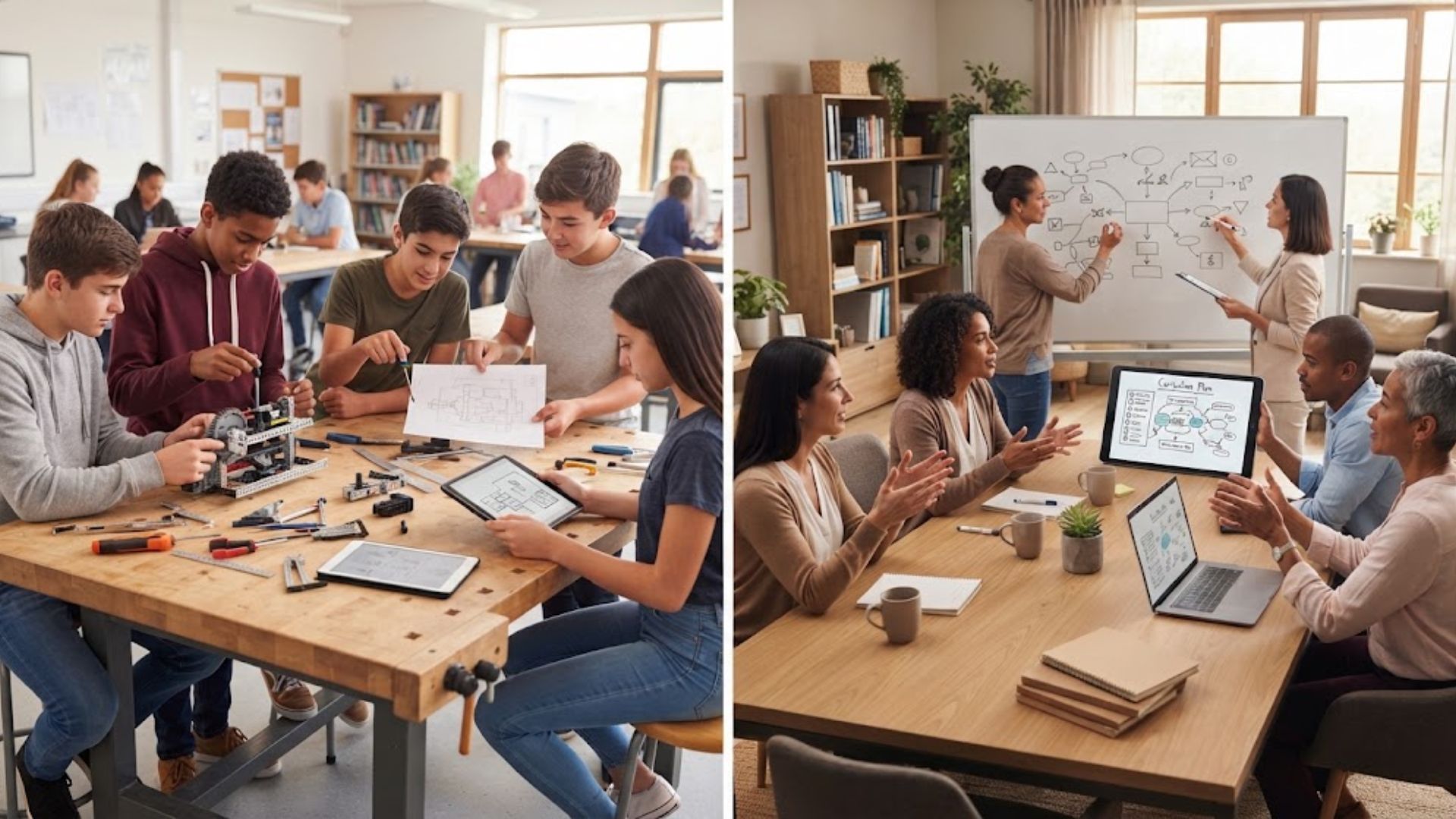
Drawing on the research of Héctor Ruiz Martín and John Hattie, the school structures its pedagogical architecture around three main pillars: project-based, personalized, and community-based learning. Under the personalized learning framework, each of the 320 students navigates an individualized plan characterized by flexible scheduling and dual guidance from faculty and peers, fostering autonomy, intrinsic motivation, and metacognitive self-regulation.
This framework demands strict operational symmetry: if students learn through collaborative projects, the faculty must mirror those practices. Consequently, every teacher follows a personalized professional learning itinerary supported by individualized mentoring and structured reflective spaces, such as dialogue and reflection circles. De la Fuente emphasized that the school’s mission rejects isolated exceptionalism; it is designed as a scalable system resource. In practice, consolidated educators trained within the institution systematically transition to lead or establish new high schools. This systemic dissemination is further enhanced by a robust program of external study stays, offering practical proof that a model operating without traditional subjects, numerical grades, or punitive measures is highly effective and reproducible.
Cultivating educational leaders to scale proven practices across the system requires absolute operational symmetry between teacher and student workflows.
Institut de Gurb: Formative Assessment and Quality Management
The leadership team from the Institut de Gurb—Director Francesc Jiménez and Quality Coordinator Núria Samsó—presented a data-driven approach to school management. Founded in 2010 to serve students across four municipalities in Osona and Lluçanès, the institute focuses on competency-based learning, rigorous formative assessment, cooperative structures, and proactive tutorial action to ensure student well-being.
The school’s administrative model frames its educational project through a continuous quality improvement system certified under the ISO 9001 standard. This framework consciously avoids treating faculty as an aggregate of isolated, autonomous actors. Instead, the institution operates within a structured organizational system featuring built-in coordination spaces, targeted professional development pipelines, and internal evaluations guided by rigorous performance indicators.
A key operational improvement involves the complete redesign of student assessment reports to provide detailed feedback to families and students regarding progress and targeted growth strategies. Moving away from uninformative global grades, the institute evaluates performance across specific skill domains. In English, for example, marks are disaggregated into oral communication, reading comprehension, and written expression, alongside transversal personal, social, and digital competency domains. These evaluation profiles include narrative feedback generated from rubrics that highlight explicit achievements and actionable opportunities for growth.
Furthermore, the institute incorporates student agency via quarterly reflection protocols where learners evaluate their personal contributions to the classroom climate, task management, and cooperative team dynamics. Students also track their own reading development and learning portfolios. To prevent this process from causing administrative overload, the school developed a custom digital tool that automates baseline comments from rubric data, which teachers subsequently review and personalize before distribution.

Assessing through disaggregated skill rubrics replaces uninformative global grades, while automated feedback loops protect vital instructional time.
Escola Virolai: Evidence-Based Decisions and Strategic Plans
Sandra Estrena and Carol Britos presented the organizational framework of Escola Virolai, a single institution serving 1,400 students across four separate campuses, spanning early childhood education through vocational training cycles.
In an educational landscape marked by intensifying academic standards, community mental health concerns, growing diversity, and rapid digital shifts, the pace of institutional change can become overwhelming. Faced with this complexity, the school rejects intuition, inertia, or reactive management in favor of data-informed decisions, collective reflection, and objective educational metrics. The core inquiry driving the institution remains constant: does this specific initiative yield a measurable, positive impact on learning outcomes for the entire student body?
This foundational principle shapes the school’s culture as a “learning organization” guided by excellence metrics like the “e2cat” framework. This operational approach requires defining clear goals, tracking accessible indicators, validating strategies through university research partnerships, and maintaining constant evaluation cycles.
This vision is implemented via three-year strategic plans, which the presenters identified as the optimal timeframe for evaluating the sustainable impact of educational interventions. The school is currently concluding a strategic cycle focused on creative thinking, built upon Harvard University research and PISA frameworks. The initial year is dedicated to defining strategic objectives and building consensus among the faculty—a deliberate process incorporating reflective pauses to ensure deep professional ownership and a shared identity. The second year focuses on execution and continuous professional learning, while the final year concentrates on rigorous impact evaluation. Crucially, these strategic initiatives do not expire at the close of the three-year cycle; they are permanently integrated into the institutional culture.
Moving from intuition to empirical evidence requires structured three-year strategic cycles to accurately measure the systemic impact of pedagogical innovation.
Innovamat: Responsible Transformation and Program Evaluation
Marc Colomer concluded the presentations by analyzing the intersection of educational research, data analytics, and real-world classroom resources. He introduced the concept of “responsible transformation,” asserting that no educational innovation should be executed out of inertia or trend-following; every shift must be thoroughly informed by empirical research and theoretical evidence. Furthermore, this process extends beyond classroom delivery: institutions must gather real-time data on impact and feed those insights back into the research cycle to drive continuous collective learning.
The initiative addresses a widespread challenge: traditional mathematics instruction that relies excessively on rote memorization and mechanical, opaque algorithms. Innovamat aims to reshape this classroom dynamic. However, Colomer warned that determining program efficacy requires moving past simplistic binary conclusions to investigate what specific strategies work, for which students, under what environmental conditions, and with what structural support. Implementation is highly complex, shaped by a multifaceted ecosystem of educators, leadership teams, families, and resource constraints.
The organization evaluates impact across three dimensions. The first is content analysis: theoretical principles are formalized within a public white paper, and research tools are deployed to evaluate the mathematical depth of classroom activities. Materials undergo external validation processes, such as the expert review committees for the State of California. The second dimension centers on implementation: annual teacher evaluations indicate that educator perception and program efficacy increase substantially starting in the second year of deployment. The final dimension measures downstream impact: an external evaluation in Rio de Janeiro documented strong positive results across five public schools, prompting the government to scale the program to 160 institutions. Additionally, schools utilizing the program show high academic performance on international assessments adapted from TIMSS metrics.
Synthesis: The True Center is Learning
In synthesis, Josep Maria Esteve isolated five core principles connecting the four institutional models: collaborative professional development must replace isolated teacher workflows; educators are the primary drivers of sustainable transformation; individual innovations risk dissolving if they are not scaled to the broader system; schools must operate as constantly learning organizations; and performance indicators must be empirically validated to ensure they demonstrably improve learning, thereby securing a responsible transformation.
Abraham de la Fuente added a critical nuance to reframe the discussion: the traditional educational axiom of placing the student at the center requires a vital pivot—the true center must be the mechanics of learning itself. Within this framework, teachers are also positioned as active learners. International data demonstrates that educational systems that provide rigorous professional development pathways and treat the faculty as active learners achieve superior academic outcomes. Learning must serve as the central backbone for the entire educational community, aligning students, educators, and the broader system in a continuous cycle of growth.

The authentic center of school transformation is not the individual student, but the process of learning itself, explicitly encompassing the faculty.
Rate the post
You might be interested