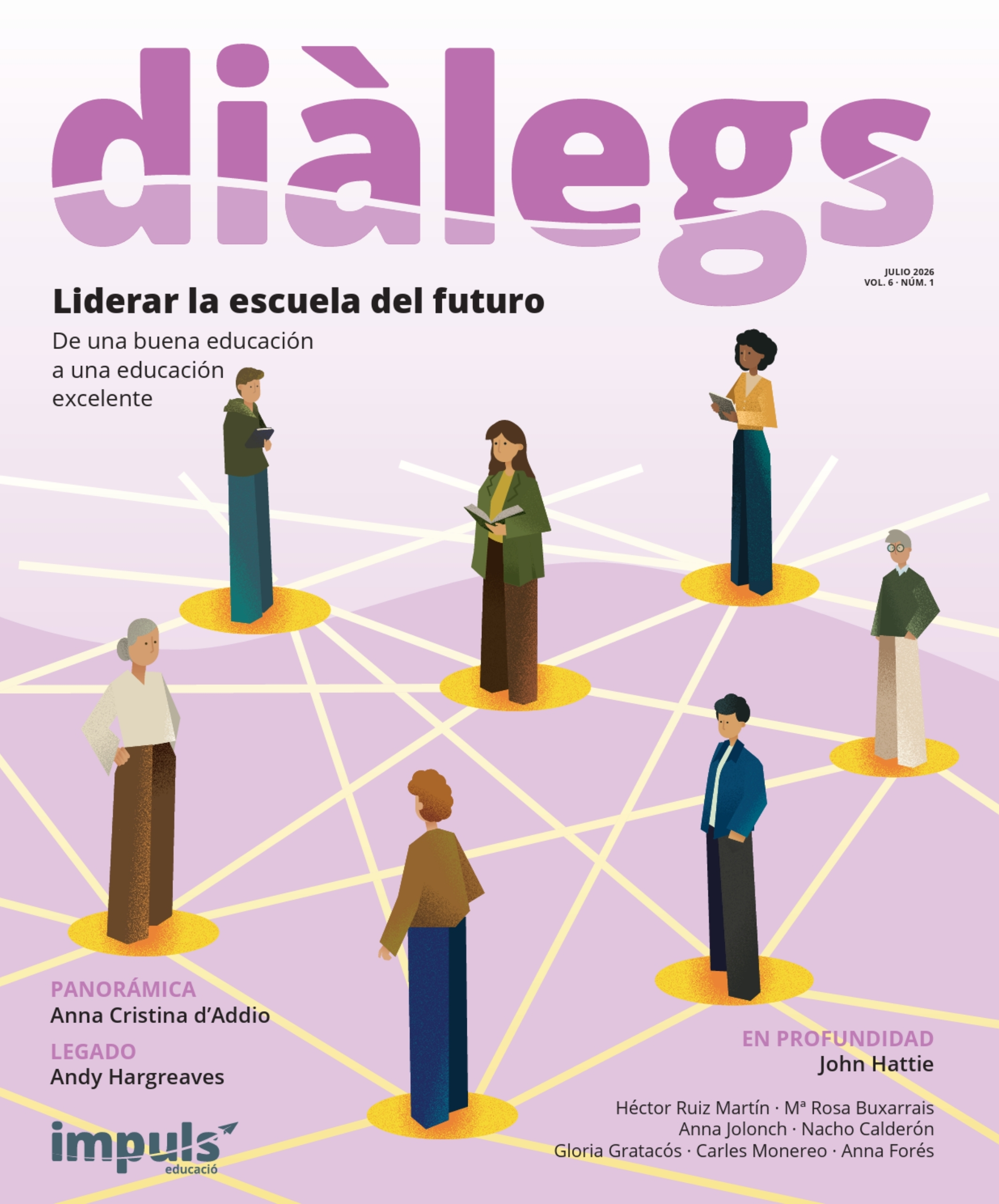
by Impuls Educació
Professor Andy Hargreaves challenges the mechanistic metaphors that traditionally dominate educational policy, advocating instead for a paradigm shift in executive leadership. His core thesis posits that the closer leaders operate to actual instructional practice, and the tighter the peer collaboration they cultivate, the more profound the systemic impact. In response to the chronic failure of top-down mandates, “leading from the middle” reclaims school principals as primary catalysts of transformation rather than passive administrators of external directives. This framework builds a robust model for improvement grounded in co-creation, social capital, solidarity, and structural solidity.
The Premise: The Closer We Are, the Better We Lead
The foundational theory of leading from the middle rests upon a deceptive principle: proximity optimizes leadership. This assertion operates on two distinct horizons. First, collective efficacy and leadership capacity accelerate when professionals collaborate deeply across traditional silos. Second, when leadership maneuvers are tightly coupled with the core business of the classroom—teaching and learning—the margin of impact increases exponentially. This framework is universally applicable to principals, middle leaders, and teacher leaders navigating within and across school communities.
Proximity drives impact: tighter peer collaboration and closer alignment with classroom practice yield the highest leadership leverage.

The Systemic Failure of Top-Down Policies
To appreciate the necessity of middle-out leadership, one must confront the stark track record of top-down governance. Longitudinal research conducted by Romain Vienne and Beatriz Pont at the OECD tracked 450 educational policies across multiple nations over a decade, revealing that over 80% of these mandates fail to achieve full implementation.
This implementation gap stems from two systemic flaws. The first is a dogmatic reliance on linear dissemination. Under the banner of “deliverology”—a corporate paradigm popularized by Michael Barber—policies are engineered at the apex of the hierarchy and pushed downward through rigid timelines, arbitrary quantitative quotas, and aggressive micromanagement. Because these frameworks routinely carry punitive sanctions, they incentivize practitioners to distort data and game the system, rendering real pedagogical impact negligible or counterproductive.

Over 80% of macro-level OECD educational policies fail to achieve authentic implementation on the ground.
Repetitive Change Syndrome and the Response of Co-Creation
The second structural barrier is what organizational theorist Eric Abrahamson terms Repetitive Change Syndrome. Educational systems frequently operate in hyper-cycles, introducing novel reforms every few years. Consequently, before a mandate can mature and yield measurable outcomes, a shifting political administration imposes a contradictory directive, inducing widespread change fatigue.
When diagnosing why specific educators languish in John Hattie’s low-impact “yellow zone,” evidence suggests they are frequently casualties of this syndrome. Far from being inherently obstructionist, these teachers have logically deduced that investing professional energy into transient, top-down initiatives is a futile exercise. Mitigating this implementation crisis requires co-creation: policies must be organically designed alongside the very stakeholders tasked with enacting them—educators, school staff, students, and the local community.
Collaboration and Social Capital in the Face of Complex Challenges
While linear initiatives can occasionally be mandated from above, complex, multi-layered policies flatly reject top-down implementation. This reality was starkly evident in the inclusive education strategy in Nova Scotia, Canada, evaluated by Andy Hargreaves and Jess Whitley. This equity framework transcended traditional special education to address gender identity, linguistic variance, immigration dynamics, and concentrated poverty.
In evaluating which leadership attributes predicted success in executing this complex mandate, two clear variables emerged. The second most potent predictor was a principal’s ability to cultivate rich internal collaboration, allowing local teams to engineer contextualized solutions. However, the single most decisive factor was the principal’s capacity to collaborate externally with peers across different school sites.
This cross-institutional leverage utilizes two forms of social capital conceptualized by Robert Putnam. Bonding capital develops internally within homogeneous professional groups sharing common values, while bridging capital links diverse professionals operating across distinct contexts. While educators naturally cultivate bonding capital, bridging capital remains the vital missing link required to solve complex, system-wide challenges.
From Engineering to Ecology: The Metaphors Framing Change
The linguistic frameworks used to articulate educational change dictate how it is operationalized. Historically, policy rhetoric has been dominated by mechanistic engineering and construction tropes: driving, delivering, scaling, and building levels. These industrial terms fundamentally fail to capture the human, relational ecosystem of schools.
A superior alternative lies in organic, ecological metaphors: growth, networks, sustainability, and the life-sustaining centers of an organism. Under an ecological lens, the role of middle leadership is transformed. While traditional theorists like Michael Fullan, Andreas Schleicher, and Michael Barber have conceptualized the middle as a mere conduit or transmission belt designed to funnel dictates from top to bottom, an ecological view positions the middle as the heart, soul, and backbone of educational transformation. Leading from the middle empowers principals to act as primary instigators of sustainable change rather than passive compliance managers.

Middle leadership must function as the heart, soul, and backbone of systemic growth, not as a passive transmission conduit.
Verstehen: The Distinctive Methodology of the Human Sciences
This ecological orientation aligns with a sophisticated epistemological tradition within the social sciences. A century ago, Max Weber argued in The Methodology of the Social Sciences that human disciplines differ fundamentally from the natural sciences: atoms do not hold opinions on their behavior, whereas human beings do. Weber advanced the concept of Verstehen (interpretive understanding), asserting that analyzing human systems requires deep engagement with the subjects’ internal perspectives.
Instructional practice cannot be reduced to a controlled laboratory experiment or a linear surgical intervention. It functions much more like community medicine, mental health, or elder care—disciplines that demand deep contextual nuance. While large-scale macro-quantities offer value, qualitative research—meticulous observation, active listening, and identifying organic field practices—is equally indispensable. Educational science must dynamically balance broad statistical averages with a deep, rigorous understanding of unique, complex cases.
Collaborative Professionalism: Solidarity and Solidity
Empirical evidence confirms that authentic collaboration drives student achievement, suppresses teacher attrition, and elevates job satisfaction. To isolate the structural mechanics of high-performing collaborative cultures, Andy Hargreaves and Michael O’Connor executed a cross-national analysis spanning five countries.
Their findings isolate two non-negotiable pillars: solidarity and solidity. Solidarity transcends superficial cordiality or artificial consensus; it requires a deep, unwavering commitment to shared values. It provides the relational trust necessary to navigate conflict, engage in difficult pedagogical debates, and present a unified front in the pursuit of equity.
Conversely, solidity addresses the structural architecture of collaboration. Relationships alone cannot sustain change; solidity demands robust protocols, clear roles, explicit accountabilities, and disciplined time management. For example, tools like the talking stick are utilized to enforce equitable participation and regulate emotional dynamics during high-stakes deliberation. High-impact leadership requires the integration of both: relationally driven leaders must inject structural solidity, while data-driven technocrats must cultivate authentic solidarity.
Meaningful teamwork requires more than good relationships; robust collaborative professionalism demands both moral solidarity and structural solidity.

Decolonizing Collaborative Professionalism
Furthermore, collaborative professionalism must be thoroughly decolonized and culturally contextualized. Collaboration manifests in highly divergent forms globally. In Hong Kong, protocols like Lesson Study operate efficiently within a deeply respected, structured hierarchy, as evidenced by the work of Veronica Yao. Conversely, in Colombia, teacher collaboration is intensely vibrant, informal, and inextricably bound to personal, social, and political passions.
When importing collaborative blueprints from foreign jurisdictions, leaders must critically analyze which core principles should remain constant and which elements must adapt to the local cultural fabric. School systems must avoid uncritical dependency on imported models, opting instead for a respectful, reciprocal dialogue with external frameworks.
Working With Resistance, Not Against It
Finally, leading from the middle requires a sophisticated approach to organizational resistance. Change agents inevitably encounter friction, yet instead of viewing resistance as an obstacle to be crushed, leaders can look to other disciplines for superior tactical metaphors. In medicine, resistance (inoculation) introduces a controlled pathogen to strengthen the organism; in electrical engineering, resistors regulate current to prevent systemic collapse; in carpentry, the master artisan works with the resistance of the wood grain, never against it.
In educational practice, working with resistance means intentionally identifying and partnering with highly respected, skeptical veteran teachers who question a new initiative. In a project funded by the Lego Foundation, an astute principal intentionally recruited Carrie Sloan, a highly structured, traditional educator deeply skeptical of play-based learning. By honoring her clinical expertise and persuading her to co-design the pilot, the principal transformed her practice and leveraged her informal network influence to convert the entire faculty.
Network theory confirms that the most critical node in an organization is rarely the individual at the formal apex of the hierarchy; it is the person sitting at the center of the informal communicative web. Identifying, dialoguing with, and persuading these central nodes allows leaders to transmute organizational friction into a powerful engine for sustainable improvement.

The nerve center of a school is not whoever heads the org chart, but whoever articulates the informal communication network.
Rate the post
You might be interested