Judgement Cannot Be Delegated · 4 of 12
It is often heard that the arrival of every new technology has provoked fear, and that this fear has, in time, turned out to be exaggerated. Socrates distrusted writing because it would weaken memory, arithmetic teachers distrusted the calculator, and today the same argument is repeated about generative artificial intelligence. It is a reasonable argument, since so far history has tended to prove the tools right. It is worth examining closely, because this time some people have set about measuring.
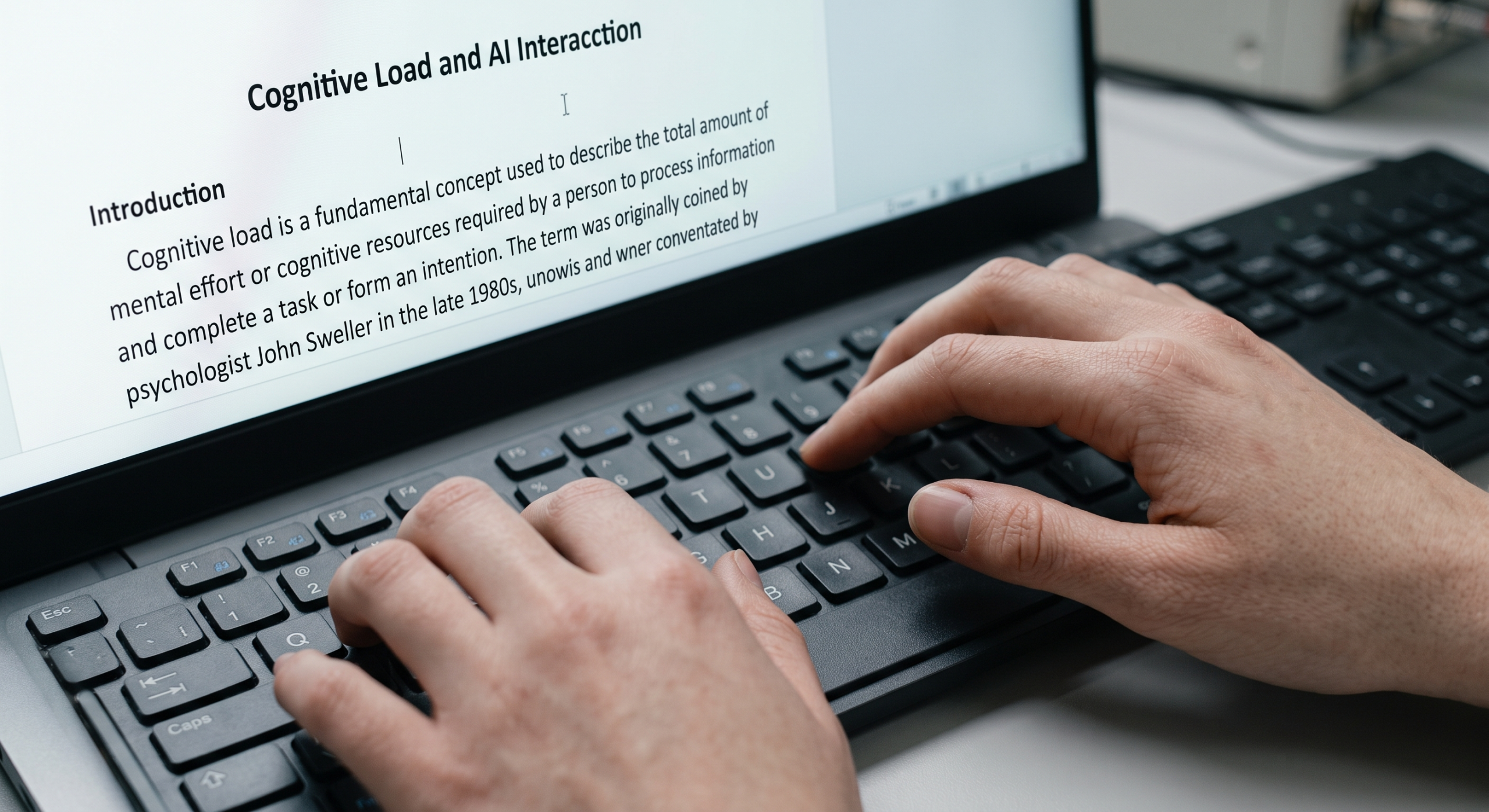
In 2025, a team at the MIT Media Lab led by the neuroscientist Nataliya Kosmyna sat 54 people down to write essays with a cap of electrodes on their heads. Some wrote with ChatGPT, others with a search engine, others with their minds alone. At the end of each session they were asked to quote from memory a sentence from the text they had just handed in. In the group that had worked with ChatGPT, not one of the eighteen managed it (2). The text had been handed in. The memory was nowhere to be found.
Everything we had already delegated
It is worth acknowledging from the outset that delegating is neither new nor suspect. Alejandro Espeso-García, of the Catholic University of Murcia, opens his review on generative artificial intelligence and cognition by recalling that the history of technology can be read as the history of the externalisation of human capacities: writing spared us memorising large volumes of information; the calculator automated numerical processing and pushed mental arithmetic into the background; and in each case the bargain was the same (1). The tool took on what was heavy or repetitive and, in exchange, the mind was left free for what was complex.
What has changed is not that we delegate. It is what we delegate.
Jorge Pereira Campos and Tatiana Koff put it precisely in an article published in 2026 in Frontiers in Developmental Psychology: a calculator takes on the arithmetic, but not the judgement about which calculation the problem calls for; a search engine takes on the retrieval of information, but not the evaluation of the sources it returns. A language model can take on planning, evaluation, composition and the construction of the argument (6). When a sixteen-year-old asks for ‘an outline for my project on climate policy’, the model holds several possible arguments in memory, weighs up which is the strongest, orders them and decides what goes in and what stays out. All of those operations are executive functions. All of them used to be done by the student.
Espeso-García quotes the cognitive psychologist Daniel Willingham with a phrase worth keeping to hand in any conversation about this: ‘memory is the residue of thought’ (1). If the tool removes the need to think, it also removes the opportunity to learn.
Unlike a calculator, artificial intelligence takes on the student’s planning and argumentative judgment.

The small print of three studies
Kosmyna’s study recorded the brain activity of the three groups over four months and found an orderly pattern: connectivity decreases as external support increases. Strongest in those who wrote without a tool, intermediate in those who used the search engine, weakest in those who used the language model. The assisted group did not only quote less well: it also only half recognised the authorship of what it had written (2).
Before going on, the small print, which here is part of the content and not a formality. The 54 participants were adults aged between 18 and 39 recruited from five universities in the Boston area. The work is still a preprint, it has not been through peer review, and in December 2025 a team headed by Milos Stankovic published a formal comment pointing out five problems: the size of the sample, the reproducibility of the analyses, the methodology of the brain recording, some inconsistencies in the results and the lack of transparency in several procedures (3). It does not refute it. It asks for it to be read with more caution, and that is what should be done.
The other two studies point in the same direction from different angles. Hao-Ping Lee, of Carnegie Mellon University, with a team from Microsoft Research, surveyed 319 knowledge workers about 936 real uses of the tool: the more confidence they placed in artificial intelligence, the less critical thinking they reported deploying, and the more confidence they had in themselves to do the task, the more (4). It is a self-report with professional adults, and the authors themselves warn that some participants confused ‘it took me less effort to use it’ with ‘I thought less’. Michael Gerlich, of the SBS Swiss Business School, surveyed 666 people in the United Kingdom and found a strong negative correlation between frequent use of the tool and critical thinking, mediated by cognitive offloading, with the youngest as the most dependent and the lowest scoring (5). It is a correlational, cross-sectional design, and it does not demonstrate causality.
There is one further caveat, and it is the one that best protects us from exaggerating: less brain activity does not mean poorer cognition, since in studies of expertise lower activation usually indicates more efficient processing (6).
Kosmyna and her team gave a name to what they believed they were seeing: cognitive debt. Mental effort that is deferred today and paid for later, in the form of less inquiry of one’s own, more vulnerability and less creativity (2). The name is a good one. What remained to be asked is who incurs the debt.

Cognitive debt reflects a mental effort saved today that is paid tomorrow with less autonomy.
The scaffold or the substitute
Executive functions, the ones that allow us to plan, hold information in mind, inhibit impulses and adapt when circumstances change, are not finished when a student starts secondary school. A study integrating four datasets with 10,766 participants aged 8 to 35 described their trajectory: development is rapid between the ages of 10 and 15, then levels off and reaches the adult level at around 18 or 20 (6). The MIT participants were between 18 and 39. Their executive functions were already built.
And there lies the paradox that Pereira Campos and Koff put forward, and that they present as a hypothesis and not as a finding: generative artificial intelligence gives its best help precisely in the tasks that demand executive functions, and it is those same tasks, done with effort, that are thought to build executive functions during adolescence (6). In an adult, cognitive debt may be temporary. In someone who is still under construction it could be of another order. The authors insist that none of this is proven, and their closing line sums up why it needs to be found out: studying what this technology does to brains that are still being built is necessary.
Out of the hypothesis comes a criterion that can actually be used on Monday: scaffold or substitute. A scaffold supports the student so that they can do something they cannot yet do alone, and what defines it is that the student goes on doing the mental work. A substitute removes it. A tool that questions the student about their essay instead of writing it, that points out the weaknesses of a draft instead of rewriting the passage, or that offers three possible structures and asks them to judge which best supports the argument and why, keeps the demand intact or increases it (6). It looks like a minor difference, doesn’t it? Well, it is the one that decides the outcome. The authors warn that current tools come configured on the substitute side.
It would be dishonest to report only the risks. Anil Doshi, of the UCL School of Management, and Oliver Hauser, of the University of Exeter, ran a preregistered experiment with 293 writers: those who received ideas from a language model produced stories rated as more original, better written and more enjoyable, and the improvement was greater among the less creative writers, to the point of levelling their scores with those of the most creative ones (7). But the assisted stories resembled one another more, so that individual creativity rises while collective novelty falls, something the authors describe as a social dilemma. And one detail of interest to any teaching staff: when evaluators were told that artificial intelligence had been involved, they imposed an ownership penalty of at least 25%.
The meta-analyses point in the same qualified direction. A review of 69 experimental studies finds that assistance with artificial intelligence tends to improve academic performance and higher-order thinking; another, of 29 experiments, finds a moderate positive effect, stronger in students who already regulate their own learning well (6). That is where the equity problem appears: the same tool, used in the same way, scaffolds one student and substitutes for another. Those who regulate their learning least well, who tend to be the youngest, are the most likely to let the tool do the thinking, and the ones who can least afford it (6).
A tool used as scaffolding guides the student; as a substitute, it eliminates their learning.
What to do with this
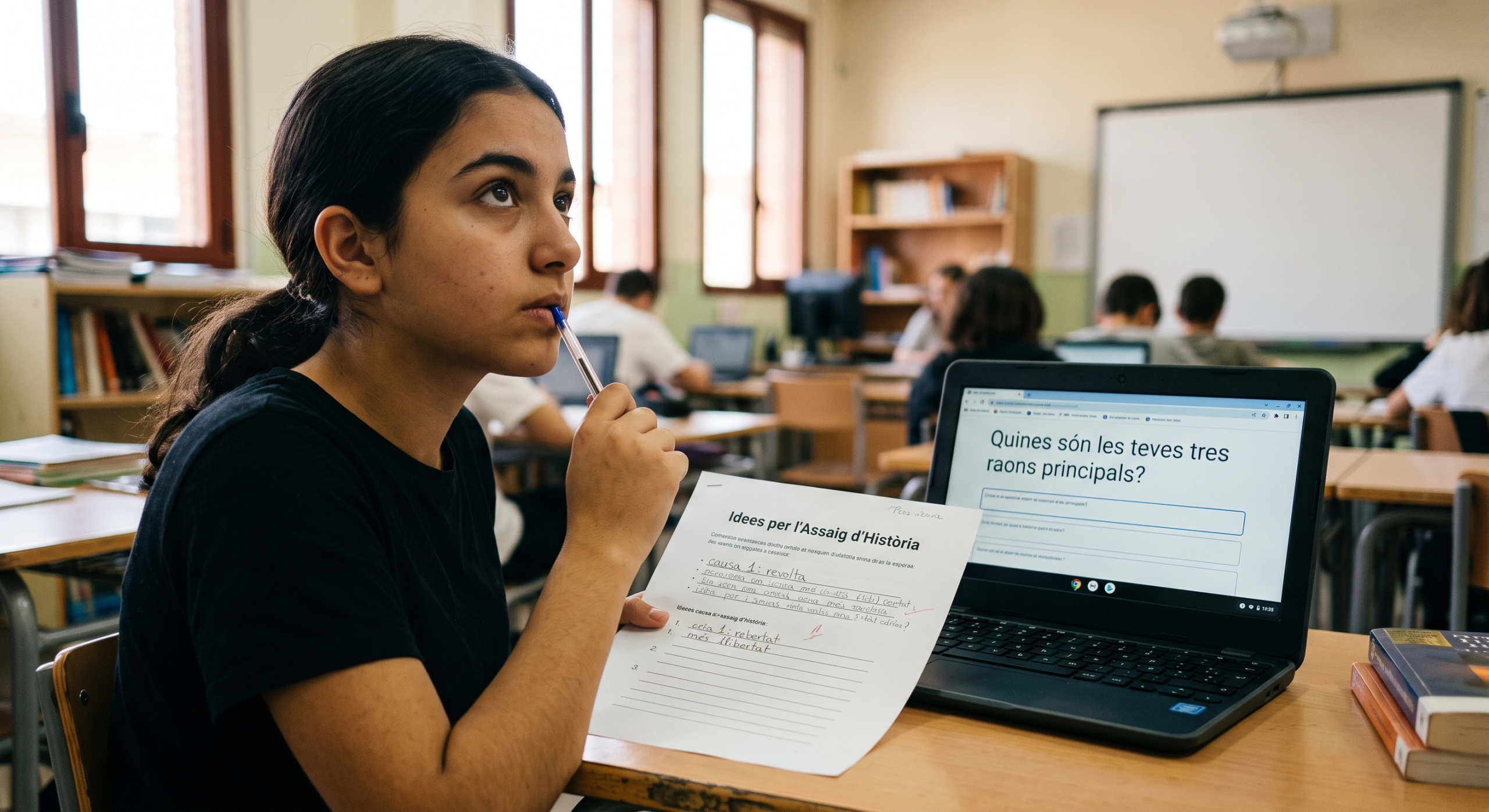
In the classroom, first without and then with. The fourth session of the MIT study crossed the groups over. Those who had previously written unaided and used the model at the end showed more connectivity than the assisted group in any of its sessions; those who took the reverse path, less. The authors themselves conclude that it is advisable to delay bringing in the tool until the learner has made enough effort on their own (2). José Antonio Bowen and C. Edward Watson have already made this concrete in one of their task lists: the student writes down their predictions about a text before turning to the search engine or the tool, because they need to preserve some skill of their own. Checking comes afterwards (8).
In the classroom, the process task. Bowen and Watson propose a template transferable to almost any subject: ask the tool to do the task, evaluate the result and list its errors, improve the instruction, keep the best version and improve it by hand, and explain in writing what the person contributed (8).
For the school, a question that can be audited. Pereira Campos and Koff point out that the distinction between scaffold and substitute can be read in the record of the conversation, in the instructions given and in the answers received. The question is where the cognitive work happened: whether the student generated the options, weighed them up and decided, or whether the model delivered a finished answer for them to approve; and whether what is left is a process, a question asked, a draft criticised, a revision requested, or only a product (6).
For the teaching staff, asking before deciding. Francesca Burriel Manzanares, doctor in Pedagogy and a teacher and researcher at the Colegio Español María Moliner in Andorra, consulted her students before introducing the tool in the school, and the result is not the one you would assume. In the first year of ESO (Year 8) they almost never check the answers, and even so they believe that without artificial intelligence their way of studying would not be affected; in the first year of Bachillerato (Year 12) they check quite a lot or a great deal, they have little confidence in the reliability of what they receive and they acknowledge that without the tool they would find things hard (9). They are two small groups, of nineteen and twenty-one students in a single school, and that is how it should be read. The direction of the contrast, however, deserves a conversation.
So does the finding of Gina María Ramírez Zöller, head of the Unidad Educativa Lemas in Guayaquil, who asked 327 students aged between 12 and 16 what worries them most about artificial intelligence in their learning. The most frequent answer, at 42.7%, was dependency, ahead of incorrect information. In the interviews they said it in their own words: the risk is becoming ‘complacent or comfortable’ when receiving information. And 70.3% believe that students should be given guidance on responsible use (10).
This does not happen in one school or one country alone. The RAND Corporation published in March 2026 a report by Heather L. Schwartz and Melissa Kay Diliberti with data gathered in December 2025 among more than a thousand American students aged 12 to 29, from secondary school upwards. The use of artificial intelligence for homework had gone from 48% in May 2025 to 62% in December, and 67% agreed that the more artificial intelligence students use for schoolwork, the more it will harm their critical thinking, more than ten points above the figure of ten months earlier (11). Use goes up, and distrust goes up with it.
It is worth saying what that 67% measures and what it does not. It measures what students believe, not what happens to them; the evidence on the latter is that of the studies in the previous section, with their limits. There is also a nuance that runs counter to the alarm: the concern is greater among those who do not use the tool, 78%, than among those who do, 60% (11). It can be read in two ways, and the report does not settle which is the right one: either use reassures because it teaches you to calibrate, or it reassures because it habituates.
But there is a third figure in the same report that does not admit of two readings, and it is the one that speaks directly to a leadership team: only about a third of students report that their school has a whole-school policy on use (11). Widespread use, widespread unease, absent guidance. There is no need to convince students of the problem. They have named it, and they are waiting for someone to teach them how to solve it.

Facing growing usage and the fear of relying on the tool, centers need clear policies.
To conclude
The impact of these tools on the learner is not a property of the tool. It is a property of how it is integrated. Used as a shortcut, it erodes; conceived as productive friction and scaffolding, it supports. Espeso-García closes his review with an image that works as a compass: the question is whether we end up acting as a pilot guided by technology or as a blind passenger in an autonomous vehicle (1). The difference between the two is not decided by the vehicle.
Food for thought. Of the tasks we have set this term, in how many does the student meet the effort before meeting the tool? And a second one, for the team meeting: if we read the record of a conversation between one of our students and a language model, would we be able to say where the work happened?
Preserving the prior effort determines whether the student acts as a conscious pilot or a passive passenger.

Glossary
- Cognitive offloading. The use of external support to reduce the load of internal processing. A diary is cognitive offloading; so is a calculator. What changes with generative artificial intelligence is not the mechanism, but what is offloaded.
- Cognitive debt. A term coined by Kosmyna’s team to describe the mental effort that is saved today and paid for later, in the form of less inquiry of one’s own, greater vulnerability and less creativity.
- Executive functions. The processes that allow us to plan, hold information in mind, inhibit impulses and adapt when circumstances change. They underpin reasoning, problem-solving and self-regulated learning, and they mature above all between the ages of 10 and 20.
- Scaffolding and substitution. Two opposite ways of using the same tool. Scaffolding supports the student while the student goes on doing the mental work; substitution removes that work. The distinction does not depend on the program, but on the use.
- Brain connectivity. The degree of coordinated activity between different regions of the brain, measured in these studies with electroencephalography (EEG). Lower connectivity indicates less coordination between regions, not necessarily poorer performance.
- Preprint. A piece of research circulated before passing peer review. It may be sound, but it has not yet been through the filter the scientific community considers a minimum.
- Correlational study. A design that observes whether two variables move together, without manipulating either. It allows you to say that two things are associated, and it does not allow you to say which causes which.
References
- Espeso-García, A. (2025). Generative Artificial Intelligence: Between Enhancement and Cognitive Offloading. Cultura, Ciencia y Deporte, 20(66), 2698.
- Kosmyna, N., Hauptmann, E., Yuan, Y. T., Situ, J., Liao, X.-H., Beresnitzky, A. V., Braunstein, I., and Maes, P. (2025). Your Brain on ChatGPT: Accumulation of Cognitive Debt when Using an AI Assistant for Essay Writing Task. MIT Media Lab.
- Stankovic, M., Hirche, E., Kollatzsch, S., and Doetsch, J. N. (2025). Comment on: Your Brain on ChatGPT.
- Lee, H.-P., Sarkar, A., Tankelevitch, L., Drosos, I., Rintel, S., Banks, R., and Wilson, N. (2025). The Impact of Generative AI on Critical Thinking. CHI Conference on Human Factors in Computing Systems.
- Gerlich, M. (2025). AI Tools in Society: Impacts on Cognitive Offloading and the Future of Critical Thinking. Societies, 15(1), 6. Correction published in Societies, 15(9), 252.
- Pereira Campos, J., and Koff, T. (2026). Your brain on ChatGPT, but whose brain? The missing adolescent in AI-cognition research. Frontiers in Developmental Psychology, 4, 1885225. Hypothesis and theory article.
- Doshi, A. R., and Hauser, O. P. (2024). Generative AI enhances individual creativity but reduces the collective diversity of novel content. Science Advances, 10(28), eadn5290.
- Bowen, J. A., and Watson, C. E. (2024). Teaching with AI: A Practical Guide to a New Era of Human Learning. Johns Hopkins University Press.
- Burriel Manzanares, F. (2026). La voz de los protagonistas: expectativas del alumnado sobre la IA [The voice of those involved: students’ expectations about AI]. In Informe ODITE 2026. Claves para una nueva educación [ODITE Report 2026. Keys for a new education]. Espiral, Educación y Tecnología.
- Ramírez Zöller, G. M. (2026). La IA bajo la lupa de los estudiantes [AI under the students’ microscope]. In Informe ODITE 2026. Claves para una nueva educación [ODITE Report 2026. Keys for a new education]. Espiral, Educación y Tecnología.
- Schwartz, H. L., and Diliberti, M. K. (2026). More Students Use AI for Homework, and More Believe It Harms Critical Thinking: Selected Findings from the American Youth Panel. RAND Corporation, RR-A4742-1.
Rate the post
You might be interested